
“We regard Remote as a foremost and dependable partner in this field. Their specialist help with local payroll, tax compliance, and HR operations has simplified our workflows and unlocked further opportunities for growth and success worldwide.”

Small business
You manage multiple roles at your company. Set the 'payroll processor' hat aside. Remote’s intuitive platform lets small businesses with 1–200 employees manage international payroll, complete tax filings, and keep compliance in order no matter where employees live.





Hire the best global talent with speed and security
Banish your HR burden and refocus on your business
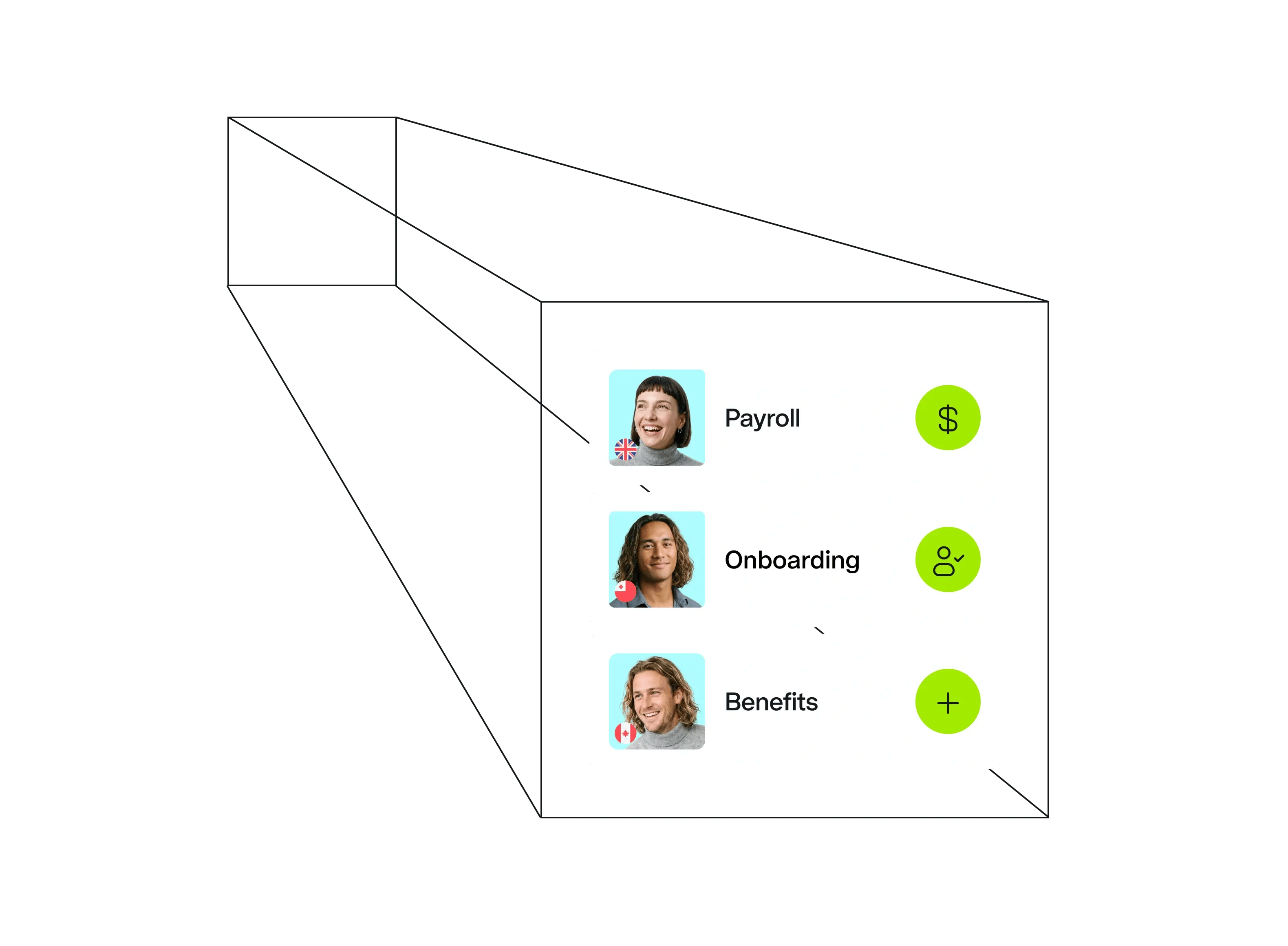
Manage all employees and contractors in one intuitive platform

What do you get when you use Remote to pay and hire your distributed team? You get a partner you can trust and a platform to rely on. That means confidence and compliance at every stage of your HR processes.
Foster ownership and morale with your team by offering stock options or equity incentives to international employees. Our global equity expertise keeps you compliant every step of the way, from equity planning to tax withholding and reporting.
Stop spending time responding to employee and contractor queries thanks to our guided onboarding process, intuitive platform (including time off and reimbursement management), and strong self-serve support resources.
Leverage Remote's 100% owned-entity model, giving you a global footprint without the burden, risk, and cost. Stay compliant during every step of the hiring and employment process with built-in security and proactive monitoring that covers right to hire, payroll, taxes, benefits, and more.
Access country-specific benefits packages at highly-negotiated prices so you can offer equitable, best-in-class benefits to your employees for a fraction of the usual cost. That means you can compete locally for talent on a global scale.

Join the customers who rely on Remote to transform their businesses.
“We regard Remote as a foremost and dependable partner in this field. Their specialist help with local payroll, tax compliance, and HR operations has simplified our workflows and unlocked further opportunities for growth and success worldwide.”

“If we had to manage and coordinate everything in-house, it would cost us well over $500,000 more each year. Remote removes that financial strain and lifts the operational load from our team, allowing us to prioritise growing our business with confidence and greater efficiency.”


“We manage monthly, semi-monthly and hourly payroll across several currencies around the world, and our Finance Manager has complete visibility in a single platform. Remote makes that possible.”


“We partner with 460+ Contractors around the world. Without Remote, I would need to hire five or six full-time employees to manage compliance, administration and payroll. Remote has certainly saved us both time and money.”

“We regard Remote as a foremost and dependable partner in this field. Their specialist help with local payroll, tax compliance, and HR operations has simplified our workflows and unlocked further opportunities for growth and success worldwide.”
“If we had to manage and coordinate everything in-house, it would cost us well over $500,000 more each year. Remote removes that financial strain and lifts the operational load from our team, allowing us to prioritise growing our business with confidence and greater efficiency.”
“We manage monthly, semi-monthly and hourly payroll across several currencies around the world, and our Finance Manager has complete visibility in a single platform. Remote makes that possible.”
“We partner with 460+ Contractors around the world. Without Remote, I would need to hire five or six full-time employees to manage compliance, administration and payroll. Remote has certainly saved us both time and money.”
“We regard Remote as a foremost and dependable partner in this field. Their specialist help with local payroll, tax compliance, and HR operations has simplified our workflows and unlocked further opportunities for growth and success worldwide.”
“If we had to manage and coordinate everything in-house, it would cost us well over $500,000 more each year. Remote removes that financial strain and lifts the operational load from our team, allowing us to prioritise growing our business with confidence and greater efficiency.”
“We manage monthly, semi-monthly and hourly payroll across several currencies around the world, and our Finance Manager has complete visibility in a single platform. Remote makes that possible.”
“We partner with 460+ Contractors around the world. Without Remote, I would need to hire five or six full-time employees to manage compliance, administration and payroll. Remote has certainly saved us both time and money.”
Small business payroll software allows businesses lacking the resources of large corporations to process payroll for team members across different locations. Although many companies operate solely within one country, remote work has enabled organisations of all sizes to hire people in multiple locations, including abroad. Whether a small business runs payroll for only a handful of staff or for a fully distributed international team, payroll software must flex to fit that organisation’s needs.
Payroll software for a small business may cover the essentials, such as delivering payments to staff on schedule and in the right amounts. For international teams, it also makes sure payments are made in appropriate currencies and, where required, via authorised banks. More feature-rich platforms like Remote provide further services, including benefits administration and globally compliant employee stock option plans.
In most situations, small businesses cannot manage payroll in-house for global teams. To pay team members in other countries legally, small businesses generally choose one of three routes: establish a legal entity in each country where employees reside, partner with an employer of record, or engage workers as contractors.
Although some companies opt to hire all workers as contractors, that approach can create complex compliance issues. Misclassification of international contractors is a serious risk that may cost a small business thousands of dollars and involve lengthy legal disputes in foreign jurisdictions. Hiring contractors internationally can work well, but only when they are genuine contractors and when you use an international contractor management platform.
Small businesses may open one or two legal entities in countries where they have significant staffing and an established business presence. However, most small businesses do not set up entities in every country where they hire, because the process is costly and can take months.
An employer of record is often the quickest, simplest solution for small businesses to operate payroll for global teams. An EOR enables a small business to employ people legally in other countries. A global employment platform such as Remote handles global payroll and taxes, administers benefits to satisfy local employment requirements, and handles all issues of compliance.
Small businesses outsource HR functions because it is generally more cost-effective than building all HR capabilities internally. The resources needed to run payroll, manage benefits, withhold taxes, make required payroll deductions, administer employee stock option plans, and keep up with changing regulations are often beyond a small business’s capacity. Even many enterprise organisations outsource HR to specialist providers.
For small businesses hiring across borders, HR challenges grow larger. Remote’s guide to international payroll processing outlines some of the difficulties small businesses encounter and offers practical guidance on managing them.
Outsourcing payroll can reduce costs for small businesses while helping to deliver a reliable employee experience. Problems with payroll and benefits management are common even in large organisations using in-house systems.
In a small business, every employee is vital to success, so mismanagement of payroll can rapidly damage the employee–employer relationship.
By outsourcing payroll, small businesses can cut administrative time and largely eliminate payroll errors. Employees expect payroll that is punctual, accurate, and consistent as a basic condition of employment.
For small businesses with limited resources, delivering completely error-free payroll in-house is challenging. Outsourced payroll solutions, however, allow even the smallest organisations to benefit from world-class payroll reliability.
Startups face different expectations and challenges compared with small businesses. Their growth phases can be sudden and unpredictable, requiring rapid pivots. Small businesses also grow, but established companies typically experience changes that are less turbulent.
Both startups and small businesses require payroll services that are reliable and flexible. Small businesses frequently lack the investor funding startups enjoy, so their costs must usually be covered by product and service sales rather than investor capital. For that reason, small businesses should take care to avoid payroll providers that charge hidden or unpredictable fees.
Small businesses should ask the right questions about payroll at the outset of any new relationship with a payroll provider.
Costs for small business payroll services vary based on employee locations, total payroll size, and the benefits the company offers. Generally, small businesses do not need to pay high fees for basic payroll services, particularly for local teams.
Small businesses with remote teams in several countries typically incur higher payroll costs, but those fees often include benefits administration, foreign tax withholding, and compliance with local employment laws.
When the choice is between hiring the right candidate or waiting longer for a local hire, onboarding an employee overseas can produce meaningful cost savings over time. For more details on costs for small business payroll across multiple countries, see Remote’s pricing page.
Employer of record services, or EORs, were once mainly used by large enterprises with substantial budgets, but that has changed. The growth of remote work has reduced EOR costs overall, enabling small businesses to access international talent without prohibitive fees or salary mark-ups.
Any small business looking to use an EOR to onboard international talent should pose the following questions to potential EOR providers:
Is this an owned-entity EOR in every country, or does the EOR subcontract services to third parties in some countries?
What protections does the EOR provide for intellectual property and invention rights?
How securely does the EOR manage your employees’ sensitive personal information?
If you offer an employee stock purchase plan, can the EOR administer that plan for you, including tax withholding?
Will you need separate platforms for contractors and employees?
Are there hidden fees that vary between countries?
Does the EOR offer special discounts for startups or social-purpose organisations?