How to set yourself up as a freelance contractor
Enjoy the freedom of freelancing and ditch the administrative load
Invoicing, tax obligations, contracts and even the simple act of being paid — all of this can feel overwhelming for an independent contractor. The good news is there are ways to cut out the time and frustration that admin causes. Use this guide as your playbook to set up fast, take payments with confidence and get your attention back where it belongs: on your clients.
How to set up the right business registration
Setting up contract agreements for new clients
How to get paid as an independent contractor
How to manage and monitor invoices
Managing independent contractor taxation obligations
Liability considerations for independent contractors
Accounting requirements for independent contractors
How do I ask the company I’m working with to convert me to an employee?
5 ways Remote makes life easier for contractors and their clients
Onboard with Remote and get set up in minutes
How to set up and get paid as a freelance contractor: your blueprint to eliminate annoying admin
As an independent contractor, you’re in charge of managing everything about your business: finding and retaining clients, completing projects, handling admin, and marketing. You’ll also need to deal with matters that may lie outside your comfort zone — for instance drafting contracts and managing taxes.
Putting a contract together can be daunting if you’re unsure which employment laws apply to your situation, especially when a client is overseas. You may also worry about receiving payments without hefty processing charges eating into your earnings.
We want to reassure you that you can handle all these responsibilities. In fact, getting set up and paid as a freelance contractor can be quick, straightforward and efficient — no matter where your clients are located.
This guide contains practical advice for independent contractors, particularly if you’re new to running your own operation. We’ll outline how to set up systems to manage your work and explain how automation can make that much easier.
We’ll cover the four most worrying areas for freelancers and show how to handle each with ease:
Contracts
Payments and fees
Invoicing
Tax
Ready to learn more about simplifying your freelance business? Let’s start at the very beginning: setting up your business.
How to set up the right business registration
To start working as an independent contractor you’ll first need to pick a legal structure for your business. That choice determines your tax and legal duties and will depend on where you’re tax resident. Different countries — and sometimes regions — have their own rules for independent contractors.
Most jurisdictions provide a few common options
Individual entrepreneur. This is a straightforward option for single contractors. In some countries, such as France there’s a legal distinction between the individual and the business; in other countries there may be no separation.
Partnership. A partnership arrangement — often with no legal separation between the partners and the business entity.
A limited liability company. A formal legal entity separate from the individual operating it. Usually the company, not you personally, is attributed the income and losses.
Other options may exist depending on where you operate. Australia, for example, offers a trust structure in which a trustee runs the business and its affairs for the beneficiaries.
Each structure has pros and cons, but many independent contractors pick the individual entrepreneur model because it’s relatively easy to establish and run.
For country-specific guidance on labour laws, check out Remote’s Country Explorer — our global hiring guides are full of practical information to help you set up your freelance business.
Read more on how to become an independent contractor

Contractor Management
Setting up contract agreements for new clients
Many contractors dislike drafting contracts for clients and may find the task intimidating, especially if it’s outside their skill set. Some might even consider skipping a contract entirely.
Not having a contract, though, is unwise. Contracts are essential because they protect you in several ways. Typically, a contract will cover:
Contracts set out the specific tasks, deliverables and project requirements. That helps prevent scope creep and ensures you’re not required to do extra work without fair payment.
Contracts spell out the payment terms, including the amount, how payment will be made and any milestones or deadlines.
Contracts cover ownership and rights to intellectual property created during the project. Clear IP clauses protect freelancers from future disputes.
Contracts set out the conditions and procedures for ending or suspending the agreement, which can shield contractors from sudden terminations.
Contracts clarify the relationship between contractor and client, helping both parties avoid misclassification issues.
Although contracts are invaluable, they can be hard to get right since contractor rights and work conditions vary by country. If you rely on a random online template or write your own without legal input, the contract may not be enforceable in some jurisdictions — and it might even disadvantage you.
Contractors can ensure their arrangements with local and international clients are above board by using Remote’s compliant, personalised contract templates. These templates are customised to country-specific legislation so contractors remain compliant regardless of a client’s location.
If you already have a contract you’re happy with, you can continue using it. When you join the Remote platform as a contractor, you can upload your own agreements instead of using ours.
Learn more about contracts here.
More on independent contractor agreements

Independent contractor agreements: a guide for businesses
The dangers of contractor misclassification
In almost every country, independent contractors are classified differently than employees. Many employee protections — such as health care, pensions and stock options — typically don’t apply to contractors. As a contractor you trade those benefits for the freedom to choose your clients and control how, when and where you work.
Even though the distinction exists, some companies may intentionally misclassify contractors to avoid legal duties; other times it happens by mistake. Whether deliberate or accidental, misclassification can lead to penalties and fines for both you and your client. The client may face significant fines in their jurisdiction, and you might face consequences for not paying the correct taxes at home.
Bear in mind it’s in your best interest to be correctly classified as a contractor.
Being a contractor gives you the freedom to work as you see fit. For instance, in the United States, for example, companies can’t dictate how a contractor performs the work or impose fixed hours. The contractor can manage their approach and schedule, provided the agreed project is completed. Proper contractor classification also gives you greater control over your earnings.
Penalties for misclassification differ by country. To avoid them, collaborate with clients to ensure your status is correct. Talk through your role and duties and review the working arrangement regularly. If your role becomes more embedded in a client’s company, you can ask to be converted into an employee.
Learn more about the risks of misclassification in the guides below

Employee and independent contractor misclassification: Expert guide

The consequences of misclassifying employees as contractors
How to get paid as an independent contractor
As an independent contractor you’re responsible for creating invoices and collecting payments. Unfortunately, that usually means billing each client separately and accepting whatever payment method they prefer — a process that can be slow and inefficient.
Some of the most common ways to collect payments include:
Bank transfers
Bank transfers — a movement of funds between two bank accounts. While generally fast, these transfers often come with substantial service fees.
Direct deposits. Funds sent straight into your bank account. Also quick, but clients may incur charges. It becomes more complex if you work with multiple clients or clients in other countries.
Paper checks. Paper checks can be deposited via an app, but the method is becoming outdated due to long processing times. Physical checks can also be lost or stolen.
Money orders. Money orders are a secure payment method usable internationally in many places but can be inconvenient. They must be bought in person and, like cheques, can be lost, stolen or delayed in the post. In some cases they might be treated as suspicious because scammers use them.
Virtual wallets. Virtual wallets are rising in popularity and are a quick way to be paid, but some clients may not accept them and there are security considerations to weigh.
Digital transfer services like PayPal and Wise. These services are fast and allow invoicing, but they may take a cut or charge high currency exchange rates, which can significantly reduce your take-home pay.
Alternatively, you can use a trusted solution like Remote. Our platform is a simple, secure and reliable way to be paid quickly in your local currency — with no hidden fees. Just add your bank account as a withdrawal method in your Remote dashboard and client payments are deposited straight into your account.
You don’t need to keep checking the dashboard to see if funds have arrived: Remote emails you the moment an invoice is paid. Learn more about how our platform can help with payments.
Your go-to guide for freelance invoicing plus a free template

How to invoice as a freelancer: a simple guide and a free invoice template
How to get paid by international clients
International payments add complexity compared with domestic ones. Currency conversion, arranging wire transfers and high processing fees can make accepting international payments stressful.
Remote simplifies the process. Our contractor management service covers more than 200+ countries and territories, allowing you to be paid in your chosen currency regardless of the currency you invoice in. Here’s how it works:
1. Invoice
You invoice your client in whatever currency suits them and upload the invoice to Remote’s contractor management platform.
2. Payment is made
The client pays its invoices in its own currency.
3. Payment is received
When Remote receives the funds, we convert them into your preferred currency before paying you out.
Contractors have two payout options. Add your bank account details directly on Remote, where payouts are powered by Wise, or use a Stripe Connect account. You can update your preferred currency and payment details at any time.
What about fees?
We work with several partners to make sure our pricing is fast and cost-effective. We do charge your clients a $29 USD fee for payment processing, but as a contractor the only charge you incur is a mid-market currency conversion fee. If you’re paid in your preferred currency, there’s no fee at all.
You can learn more about our fees in this support center article.
How to manage and monitor invoices
Invoicing as an independent contractor can be tedious. Many contractors end up using a collection of tools to manually create, send and track invoices — a slow, error-prone approach.
By automating your invoicing, you can simplify billing and spend more time on billable work. Remote can help with that.
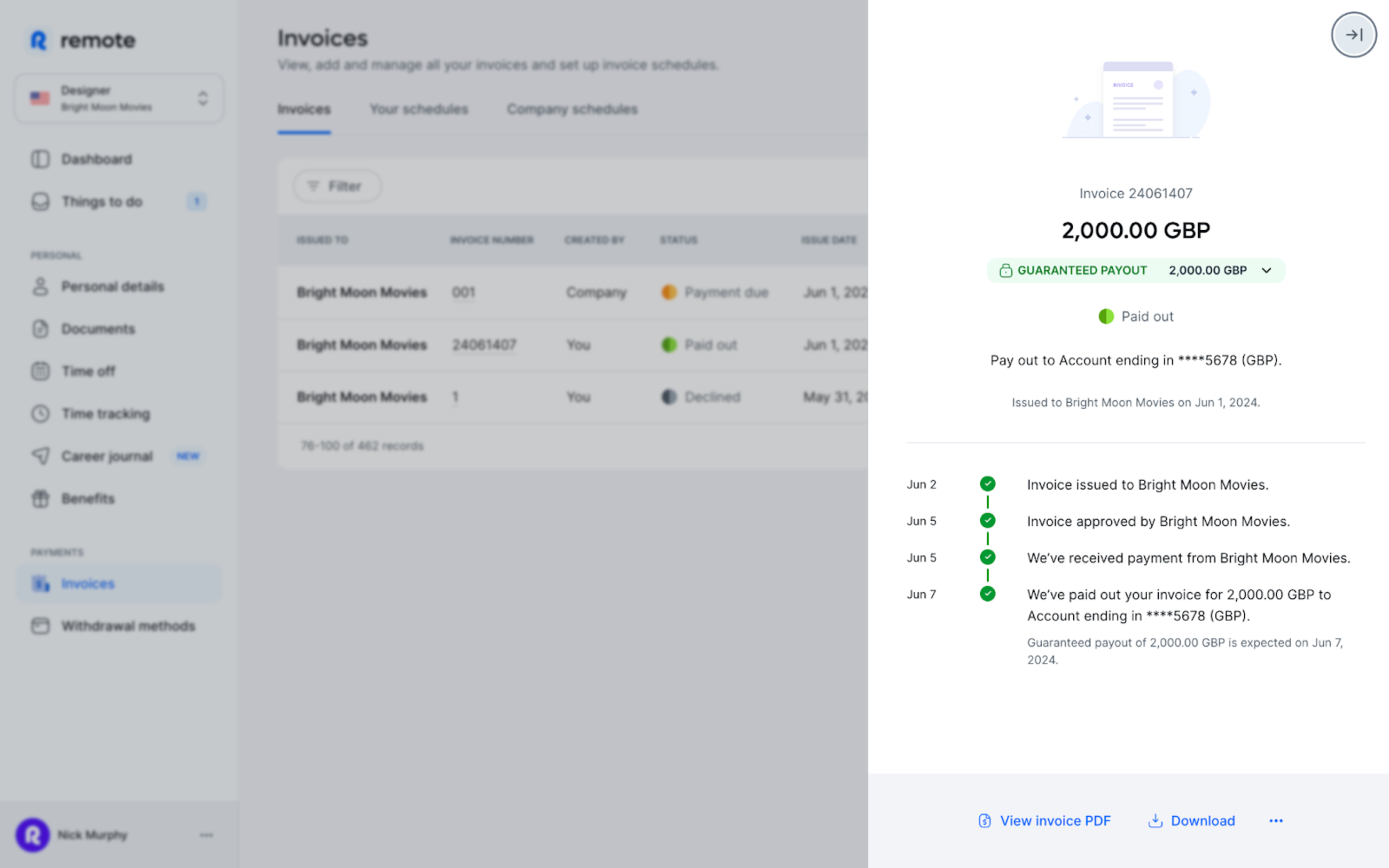
With Remote you no longer need spreadsheets, email chains or other manual tools to manage invoices. Our platform lets you create invoices, submit them for approval and receive payment in your local currency without switching to different software. Upload your invoices to Remote, we’ll route them to clients and show status updates as they move through approval.
Setting up billing
As a contractor you submit invoices to clients through your Remote dashboard. There are two ways to do this:
1. Upload your own invoice
Create an invoice that shows the invoice date and amount, then upload it as a PDF.
2. Create an invoice on Remote
Use our templates to generate an invoice on the platform. You can also set up recurring invoices that are sent automatically to your client.
To learn more, check out this article in our Help Center.
Managing independent contractor taxation obligations
As an independent contractor you’re responsible for paying your own taxes. Tax systems vary by country, so the way taxes are handled differs depending on where you operate.
In the US, for example, you pay taxes directly to the government. In other places, clients may be required to withhold tax from your payment. For details about contractor tax obligations where you live, visit Remote’s Country Explorer page.
That’s one reason correct contractor classification matters: it affects how you pay tax.
Liability considerations for independent contractors
As an employee, the company usually handles liability. As a sole trader, however, you can be personally liable for financial and tax debts, which means personal assets might be used to settle business obligations. To reduce this risk, many contractors take out liability insurance.
It’s also wise to protect yourself legally when you draft and sign agreements with clients. Remote’s legal team reviews our contract templates so they comply with the laws in the country where you work.
Take charge of your business with Remote Freelancer Hub
Manage your clients, organise contracts, invoices and get paid — all in one place.
Accounting requirements for independent contractors
Independent contractors don’t need to publish annual financial statements, but you must keep organised records — including client invoices and business purchases — so you can track income and prepare tax returns.
You can manage your records using accounting or bookkeeping software, or by hiring a professional bookkeeper or accountant.
Consider opening a separate bank account for business transactions; some countries require a business account once turnover exceeds a certain threshold.
How do I ask the company I’m working with to convert me to an employee?
Start a conversation with your client and outline the risks and advantages of switching to an employer–employee arrangement. Be clear about how the change benefits both sides — not only you. There are several reasons a company might want to convert you to an employee. For example, the client would then control your hours and how you perform tasks.
Listen to your client’s concerns. International clients may be reluctant to hire you directly unless there’s a legal entity in the country you’re working from. If that’s the case, suggest they use an Employer of Record (EOR).
An EOR helps companies employ staff in other countries by acting as the local employer on the company’s behalf. Typically, an EOR also handles HR admin like local payroll, benefits administration and tax compliance.
Remote, for example, is an EOR and can help your client remain compliant with local laws during the transition.
To learn more about advocating for yourself as a remote worker, download our Remote Toolkit.
5 ways Remote makes life easier for contractors and their clients
There’s a lot to consider when you set up as an independent contractor. Remote can help with many of these challenges so you can concentrate on growing your business and delivering for clients. Here’s how:
Learn more about how Remote can help you as an independent contractor here.
Onboard with Remote and get set up in minutes
Having the freedom to work on your terms is liberating. But admin can pull you away from what you’d rather be doing: helping clients, getting paid quickly and growing your business.
Using a stable, trusted platform like Remote means you can manage these obligations quickly and efficiently and stay focused on your business goals.
Our platform makes it quick and simple to get started as an independent contractor — we guide you through onboarding and verify your identity for security. You’ll also be prompted to upload any required tax documents for secure storage.
Learn more about how Remote can save you — and your clients— time and resources.
Get started with Remote today.