How to register as a freelance contractor
Enjoy the independence of freelancing while removing the administrative hassle
Invoicing, tax compliance, contracts and even simply receiving payment can feel overwhelming for a solo contractor. Thankfully, there are practical ways to remove the time drain and frustration of admin work. Use this blueprint to set up payment flows quickly and confidently so you can refocus on what matters most: serving your clients.
How to set up the right business registration
Setting up contract agreements for new clients
How to get paid as an independent contractor
How to manage and monitor invoices
Managing independent contractor taxation obligations
Liability considerations for independent contractors
Accounting requirements for independent contractors
How do I ask the company I’m working with to convert me to an employee?
5 ways Remote makes life easier for contractors and their clients
Onboard with Remote and get set up in minutes
How to set up and get paid as a freelance contractor: your blueprint to eliminate annoying admin
As an independent contractor, you must manage everything related to your operation: winning and retaining clients, delivering projects, running admin, and marketing. You may also need to handle tasks beyond your core skills, such as preparing contracts and managing taxes.
Drafting a contract can be stressful if you are unsure which employment laws apply to your work, particularly when the client is overseas. You may also worry about receiving payments while losing a chunk to processing charges.
We want to reassure you that you can handle all of these matters. In fact, registering and getting paid as a freelance contractor can be quick, straightforward and efficient — regardless of where your clients are located.
This guide provides practical assistance for independent contractors, especially if you are new to running your own business. We explain how to establish a consistent workflow and how automation can simplify those tasks.
We cover the four most daunting areas for freelancers and outline how to manage each with confidence:
Contracts
Payments and fees
Invoicing
Tax
Ready to learn more about simplifying your freelance business? Let’s start at the very beginning: setting up your business.
How to set up the right business registration
To start working as an independent contractor, you must first select a legal structure for your business. That choice determines your tax and legal responsibilities. The appropriate structure depends on where you claim tax residency, since countries — and sometimes regions — have differing rules for contractors.
Most jurisdictions provide a few standard options
Individual entrepreneur. This is a straightforward option for sole contractors. In some countries, such as France, a legal distinction exists between the person and the business; elsewhere there may be no such separation.
Partnership. A formal partnership agreement between two or more people. Often the partners and the business are treated the same for legal and tax purposes.
A limited liability company. A distinct legal entity that separates the company’s finances from your personal assets. Typically, profits and losses belong to the company rather than you personally.
Other models may exist depending on the country. For instance, Australia offers a trust structure where a trustee runs the business on behalf of beneficiaries.
Each option has advantages and drawbacks, but many contractors opt for the individual entrepreneur route because it is simple to establish and operate.
For country-specific employment rules, consult Remote’s Country Explorer — our global hiring guides contain practical details to help you establish your freelance operation.
Read more on how to become an independent contractor

Contractor Management
Setting up contract agreements for new clients
Many contractors dislike drafting contracts and may find the task daunting, especially if it sits outside their skill set. Some even contemplate proceeding without any contract.
Skipping a contract is unwise. Contracts are essential because they provide legal protection. Typically, an agreement will address:
Contracts specify tasks, deliverables and project requirements. This prevents scope creep and protects freelancers from being asked to perform extra work without appropriate compensation.
Contracts set out payment terms, including amounts, payment methods and any milestones or deadlines.
Contracts clarify ownership and rights for intellectual property produced during the engagement. Clear IP clauses protect freelancers from disputes.
Contracts describe the conditions and process for terminating or suspending the agreement, shielding contractors from abrupt cancellations.
Contracts clarify the client–contractor relationship and help both parties avoid misclassification issues.
Useful as they are, contracts can be complex because contractor rights and employment conditions vary internationally. If you rely on a generic template or draft your own without local insight, the agreement may not be enforceable in some jurisdictions and could even disadvantage you.
Contractors can ensure their arrangements with local and overseas clients are compliant by using Remote’s tailored contract templates. These are adapted for country-specific laws to help contractors remain compliant no matter where the client is located.
If you already have a contract you prefer, you may continue to use it. When onboarding as a contractor on the Remote platform, you can upload your own agreements instead of using ours.
Learn more about contracts here.
More on independent contractor agreements

Independent contractor agreements: a guide for businesses
The dangers of contractor misclassification
In most countries, independent contractors are classified differently than employees. Many employee benefits such as health care, pensions and share options usually do not apply to contractors. As an independent contractor, you trade those benefits for the autonomy to choose clients and control when, where and how you work.
Despite the distinction, some companies may intentionally misclassify contractors to avoid obligations; other cases occur accidentally. Whether deliberate or not, misclassification can result in penalties and fines for both you and your client. The client may face heavy sanctions in their jurisdiction, and you could suffer consequences for incorrect tax treatment in your country.
Bear in mind that being correctly classified as a contractor is in your best interest.
First, a properly classified contractor retains the freedom to work as they choose. In the United States, for example, companies cannot dictate how a contractor performs their work or impose fixed hours. The contractor controls their methods and schedule, provided the project is completed. Second, contractor status gives you greater control over income.
Penalties for misclassification vary by country. To prevent problems, clarify your role and responsibilities with clients and review the arrangement periodically. If your relationship becomes more integrated into the client’s operations, you can ask to be converted into an employee.
Learn more about the risks of misclassification in these guides

Employee and independent contractor misclassification: Expert guide

The consequences of misclassifying employees as contractors
How to get paid as an independent contractor
As an independent contractor, you are responsible for issuing invoices and collecting payments. This often means billing each client separately and accepting whatever payment method they prefer, which can be inefficient and time-consuming.
Some of the most common ways to collect payments include:
Bank transfers
Bank transfers, a transfer between two bank accounts. While typically fast, such transfers often incur significant service charges.
Direct deposits. A direct credit into your bank account. Also speedy, but clients may face fees and the arrangement can be complex when dealing with multiple or international clients.
Paper checks. Paper checks can now be deposited via mobile apps, but they are increasingly outdated due to slow processing and risks of loss or theft.
Money orders. Money orders are a secure international payment method in many countries but are inconvenient: they must be bought in person and, like checks, can be lost, stolen or delayed. They can also be flagged as suspicious since scammers sometimes use them.
Virtual wallets. Digital wallets are growing in use and offer fast payments, but they are not universally accepted by clients and there are security considerations.
Digital transfer services like PayPal and Wise. These services are convenient and support invoicing, but they can deduct fees or apply unfavourable exchange rates, which may significantly reduce your net payment.
Alternatively, use a trusted provider such as Remote. Our platform offers a simple, secure and dependable way to receive funds rapidly in your local currency — with no hidden charges. Add your bank account as a withdrawal method on your Remote dashboard and client payments will be deposited straight into your account.
You do not need to keep refreshing the dashboard to confirm payments: Remote emails you as soon as an invoice is settled. Learn more about how our platform can help with payments.
Your practical guide to freelance invoicing plus a free template

How to invoice as a freelancer: a straightforward guide and a free invoice template
How to get paid by international clients
Receiving international payments is more complicated than domestic ones. Currency conversion, coordinating wire transfers and high processing charges can make accepting international payments a source of stress.
Remote simplifies this. Our contractor management service covers more than 200+ countries and territories, enabling you to be paid in your preferred currency regardless of the invoice currency. The process works like this:
1. Invoice
You bill your client in the currency that suits them and upload the invoice to Remote’s contractor management platform.
2. Payment is made
The client settles invoices in their own currency.
3. Payment is received
Once Remote receives payment, we convert it to your chosen currency before sending the payout to you.
Contractors have two payout options. You can add bank account details to Remote where payouts are powered by Wise, or you may use a Stripe Connect account. You can update your preferred currency and payment details at any time.
What about fees?
We partner with multiple providers to keep pricing fast and as affordable as possible. We do charge your clients a $29 fee for payment processing, but as a contractor, the only fee you pay is a mid-market currency conversion fee. If you’re being paid in your preferred currency already, there’s no fee at all.
You can learn more about our fees in this support centre article.
How to manage and monitor invoices
Invoicing as an independent contractor can be tedious. Many contractors end up using a mix of tools to manually create, send and track invoices, which is inefficient. Manual processes are slow, repetitive and prone to mistakes.
By automating your invoicing, you can streamline billing and return more time to paid work. Remote can help deliver that automation.
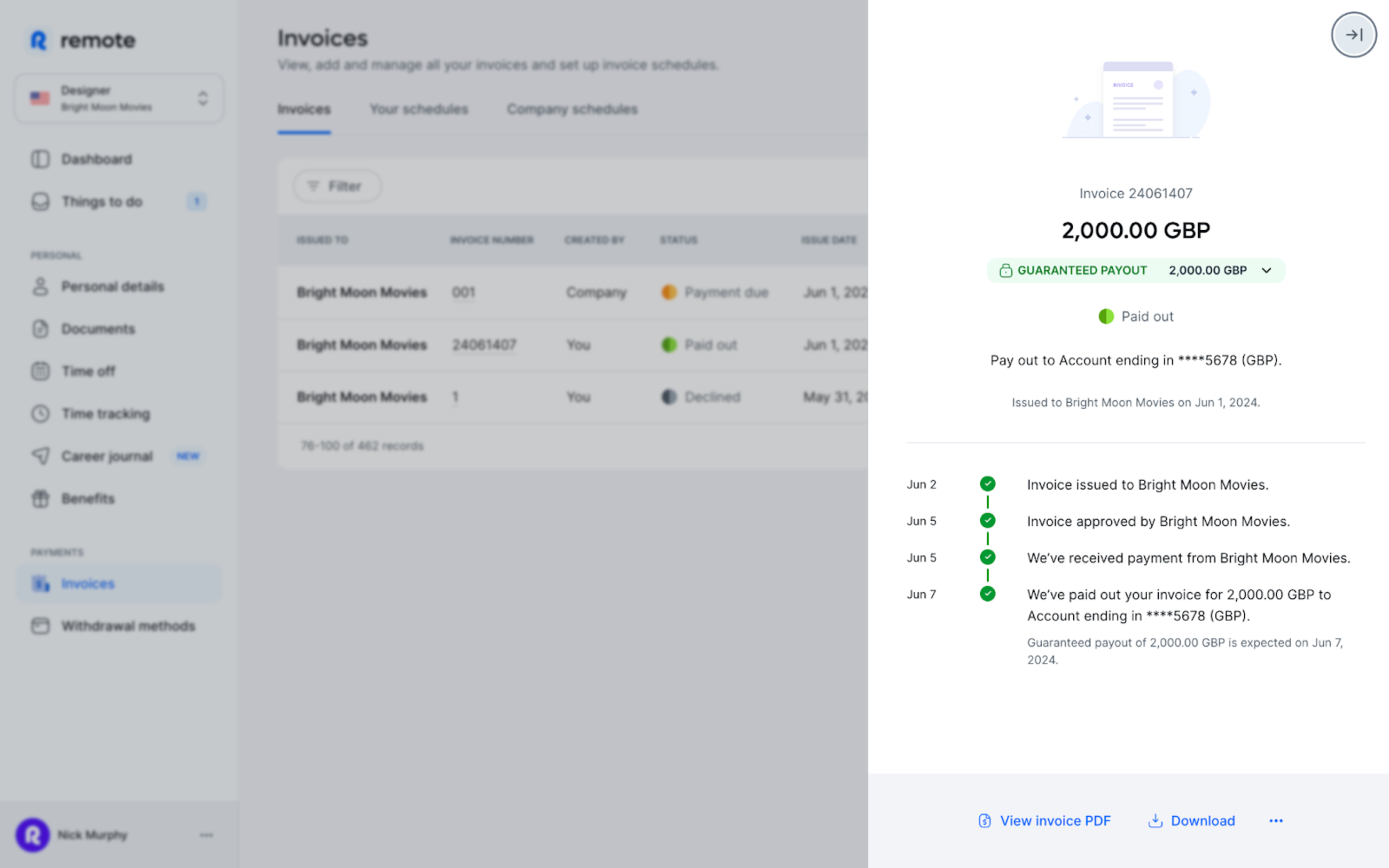
With Remote you no longer need spreadsheets, email threads or disparate tools to manage invoices. Our platform lets you create invoices, submit them for approval and receive payment in your local currency without switching software. Upload invoices in Remote, we route them to clients and you receive live status updates as each invoice progresses through approval.
Setting up billing
As a contractor, submit invoices to clients via your Remote dashboard. You can do this in two ways:
1. Upload your own invoice
Create an invoice showing the invoice date and amount, then upload it as a PDF.
2. Create an invoice on Remote
Use our templates to build an invoice on the platform. You can also set up recurring invoices to be sent automatically to your client.
To learn more, read this article in our Help Centre.
Managing independent contractor taxation obligations
As an independent contractor you are responsible for your own taxes. Tax systems differ by country, so how taxes are handled varies across jurisdictions.
In the US, for example, contractors remit taxes directly to the government. In other places, clients may be required to withhold tax from payments. For detailed tax obligations in your jurisdiction, visit Remote’s Country Explorer page.
This is another reason why correct contractor classification matters: it affects how you meet tax obligations.
Liability considerations for independent contractors
As an employee, a company typically absorbs liability. As a sole proprietor, you bear personal liability for financial and tax debts, meaning personal assets could be used to satisfy business liabilities. To reduce this exposure, many contractors obtain liability insurance to mitigate the risk.
It is equally important to protect yourself legally when negotiating and signing client agreements. Remote’s legal team reviews our templates to help ensure compliance in the country where you operate.
Take charge of your business with Remote Freelancer Hub
Manage your clients, organise contracts, invoices and get paid — all in one place.
Accounting requirements for independent contractors
Independent contractors are not required to publish annual financial statements, but must keep orderly records of accounts, including client invoices and business expenses, to monitor income and meet tax obligations.
You can maintain records yourself using accounting or bookkeeping software, or engage a professional bookkeeper or accountant.
Consider opening a separate bank account for business transactions; some jurisdictions require a business account once turnover exceeds a threshold.
How do I ask the company I’m working with to convert me to an employee?
Begin a conversation with your client and outline the risks and benefits of moving to an employer–employee relationship. Emphasise the mutual advantages — not only those that favour you. There are several reasons a company might wish to convert you to an employee. For example, highlight that the client will control your hours and the way tasks are performed.
Listen to client concerns. International clients might be unable to hire you directly without a local legal entity. Suggest they use an Employer of Record (EOR) in that situation.
An EOR is a company that employs workers on a client’s behalf in another country. Typically an EOR handles HR admin including local payroll, benefits and tax compliance.
Remote, for example, is an EOR and can support the transition while keeping your client compliant with local law.
To learn more about advocating for yourself as a remote worker, download our Remote Toolkit.
5 ways Remote makes life easier for contractors and their clients
As shown, there is a lot to address when establishing yourself as an independent contractor. Remote can assist with many of these tasks so you can concentrate on growing your business and delivering for clients. Here’s how:
Learn more about how Remote can help you as an independent contractor here.
Onboard with Remote and get set up in minutes
Having the freedom to work on your own terms is empowering. Yet administrative duties can distract you from your priorities: helping clients, getting paid promptly and expanding your business.
Using a reliable platform such as Remote lets you handle these obligations efficiently so you can concentrate on achieving your business goals.
Our onboarding process is quick, simple and seamless — we walk you through registration and identity verification for security, and prompt you to upload any required tax documents for secure storage.
Learn more about how Remote can save you — and your clients—- time and resources.
Get started with Remote today.