.png?branch=production&width=3840&quality=90&auto=webp&disable=upscale)
2024 state of payroll report: how payroll mistakes carry hidden costs
Discover the forces shaping the future of payroll, drawing on insights from over 2,500 professionals and 1,300 HR decision-makers worldwide. Download the complete report to learn how to make payroll work for your organisation. Inside, you will find:
- The most common mistakes and how to avoid these risks
- How payroll errors harm productivity, morale and staff retention
- Practical guidance for turning payroll into a strategic business function
Download now: research/impact-of-payroll-mistakes
Download now
Whether it’s a late salary or an incorrect pay, many people will have dealt with a payroll mistake at some stage. But what are the real consequences for those affected?
A payroll error is rarely just an administrative nuisance for the employee — it can disrupt banknote payments, family plans and everyday social life. Aside from the direct financial consequences, payroll mistakes often damage employee morale and mental wellbeing.
As Jonathan Goldsmith, Remote’s VP of Payroll, points out, “Pay is not about work, it’s about life. Getting paid incorrectly can stop you from being able to take care of your family and yourself. It might affect your holiday plans, or mean you’re unable to save for future things such as school fees or even a new home.”
Payroll issues cover any discrepancy or fault in the payroll cycle, including pay errors, incorrect worker classification or inconsistencies with tax subsidies.
At Remote, we view payroll not merely as an administrative chore — it is a core HR capability for organisations and essential to building trust, preserving morale and motivating teams. Errors and poor transparency around payroll create doubt, anxiety and can damage the relationship between employers and their workforce.
To assess the global state of payroll and measure how payroll problems affect employees worldwide, we surveyed more than 2,500 professionals across a range of demographics and sectors in the UK, US and Germany, and also spoke to more than 1,300 HR decision-makers responsible for payroll.
How exactly do payroll issues truly impact employers and employees? Let us examine the data.
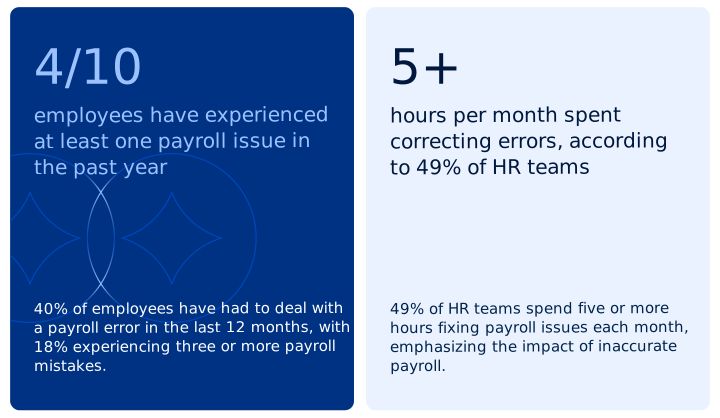
Our survey underlines the critical need for accuracy and transparency: payroll mistakes affect both staff and organisations and can create serious operational bottlenecks as well as harm relationships.
"Payroll is a core HR function that should be viewed as inherently people-centric. This is crucial in avoiding an erosion of trust and helping businesses maintain a strong reputation and standing among employees." - Jonathan Goldsmith, VP of Payroll at Remote
More than half of employees have faced payroll issues
Fifty-three per cent of employees surveyed had faced a payroll issue in their career, with half of respondents reporting at least one incident within two years of the survey. Forty per cent experienced an error in the past year, and nearly 11% had a payroll mistake in the previous month.
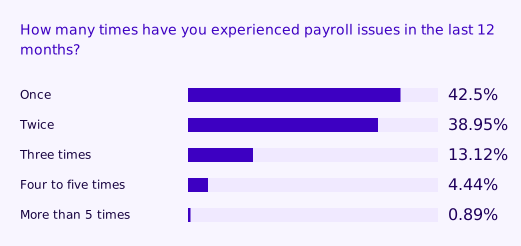
Among those reporting an error in the past year, 43% said it happened only once, but over 18% experienced three or more mistakes in a single year — younger workers (16–24) reported the highest frequency.
Although 7 in 10 organisations (71%) that outsource payroll reported improved accuracy, employers must not become complacent — nearly half (49%) of HR teams still spend five or more hours each month resolving pay-related issues, a burden that is particularly evident in larger companies.
Who is most likely to encounter a payroll error?
Younger employees are more likely to experience a payroll error. Over 70% of 16-24-year-olds surveyed encountered a payroll error in the past two years, compared with just 30% of those aged 55 and over. While Gen Z workers are less diligent about checking payslips (47% don’t check theirs every month), the higher incidence of errors may reflect less role stability, since younger staff tend to change jobs more frequently.
Payroll mistakes are more common in US workplaces. US employees are 26% more likely to experience a payroll error than their UK counterparts, and a quarter of workers in America reported a payroll issue in the last three months. More frequent pay cycles—most Americans are paid every two weeks—alongside a notoriously complex US tax system may help explain this trend.
Remote workers are less likely to encounter payroll issues. Surprisingly, only 17% of fully remote employees reported a payroll error in the past three months, compared with 22% of hybrid and 22% of fully in-person staff. Fully remote employees also check payslips less often (41% don’t check theirs every month, versus 31% of in-person workers), but remote-first companies may operate with stricter, more reliable payroll processes out of necessity.
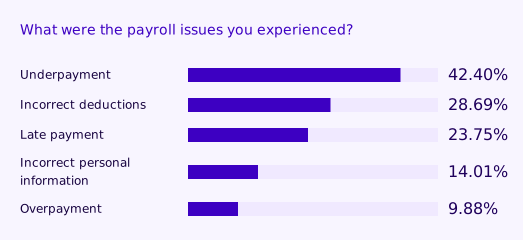
The survey also found that underpayment is the most common payroll issue. Among those who experienced an error, 42% reported being underpaid, while almost a quarter (24%) received a late payment. Overpayment accounted for roughly 1 in 10 cases.
In cases of late payment, the majority of issues are resolved within a week (60% of those reporting late pay said wages arrived within seven days), but others waited longer — about 18% were left waiting more than two weeks, and almost 7% experienced delays of one month or more.
Download the full report to discover how to reduce payroll errors
Understand the fallout of payroll mistakes. Download our State of Payroll Report to find out how payroll errors affect employees and how to minimise your risk.
Stress and anxiety are the most significant effects of payroll errors
Among the 53% of employees who encountered at least one payroll error, nearly a quarter (24%) reported a delayed payment as one of the problems they experienced.
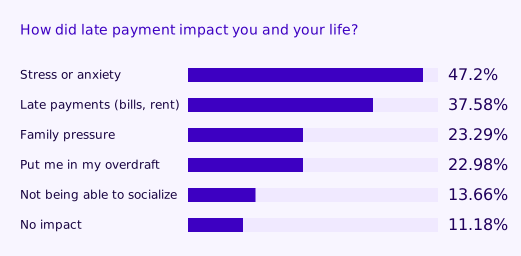
Respondents indicated that the single most common effect of late pay was “stress and anxiety” (47%). “Family pressure” ranked third (23%), showing that the emotional toll of late payments is often as significant as the financial one.
Financial strain is also common. Almost two-thirds of respondents said late payslips caused them to make late payments for banknotes and rent or pushed them into their overdraft.
"Payroll affects people, and it’s an emotional thing. It has a significant impact on the morale of the employees in the organisation. After all, if an employee doesn’t get paid correctly, or they don’t get the pay they expect, this could result in them missing a medical payment or something equally as vital.” - Jonathan Goldsmith, VP of Payroll at Remote
By contrast, our survey of HR decision-makers found that although 95% of employers acknowledge payroll discrepancies affect employees, fewer than a quarter (24%) believe they have a significant impact. A larger share (30%) say the effect is small or non-existent — highlighting a possible disconnect between employees’ experiences and HR leaders’ perceptions of payroll problems.
Who is most affected by payroll mistakes?
Women are more likely to feel payroll-related anxiety. Female employees report the emotional impact of payroll errors more acutely than male colleagues, with over half (52%) of women feeling stress and anxiety after a late payment, compared with 42% of men.
Younger generations are more prone to stress from late payments. Those aged 55+ report the lowest emotional effect from a payroll mistake (just 25% feel impacted), while more than half (53%) of people aged 35–44 report stress or anxiety — likely reflecting greater financial and family commitments.
Employees in the US show higher anxiety about payroll mistakes.Although US workers are more likely to face payroll issues, they also report greater stress or anxiety when mistakes occur. 56% of US employees reported feeling high levels of stress from a late payment, compared with 35% of the UK workforce.
Remote workers report greater stress over delayed pay. Possibly because they may feel more isolated when issues arise, two-thirds (66%) of remote employees say delayed wages have caused them stress. This compares with 51% of hybrid workers and 44% of in-house employees.
Payroll errors can affect employee-employer relations
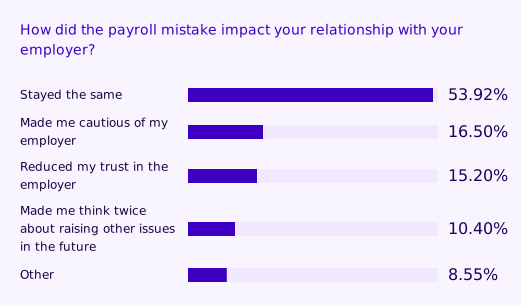
Another major consequence of payroll mistakes is damage to the employer–employee relationship, often eroding trust. Although over half of employees reported no change after a payroll issue, 42% said their relationship with their employer worsened.
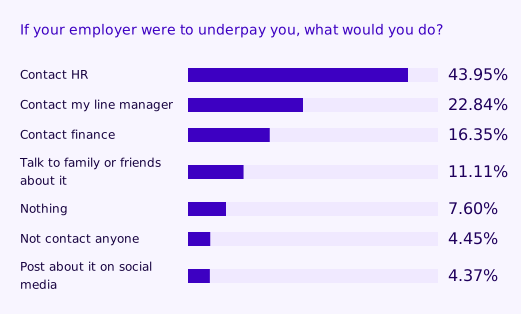
There is also reputational risk: when asked how they would react to being underpaid, over a fifth (21%) said they would lodge a complaint or post on social media — actions that could harm the employer’s public standing.
“There are functions within a company like payroll that work for the employee, and they need to remember that and own the impact. The after-effects of poorly running payroll to a business are factors like retention, sentiment, and motivation — those are really big things.” - Jonathan Goldsmith, VP of Payroll at Remote
Our HR decision-maker survey reveals a disconnect: nearly 24% identify faster payments as the main benefit they want from payroll solutions, while reducing errors (21%) ranks sixth — suggesting employers may underestimate the broader impact of payroll mistakes.
How do payroll issues affect employee-employer relations?
Greater caution and diminished trust are the most common negative consequences. Almost a third (32%) of employees who experienced a payroll mistake said this had made them more cautious of their employer or reduced their trust in them. Just over 1 in 10 would be more reluctant to raise issues in the future.
Younger employees are likelier to view their employer negatively after a payroll error. 71% of employees aged 16–24 experienced a negative change in their relationship with their employer following a payroll error. Conversely, almost two-thirds (65%) of those aged 45–54 reported no change in employee-employer relations.
Remote employees are less prone to alter their view of their employer after a payroll mistake. 60% of remote workers experienced no change in their relationship with their employer, which may reflect greater confidence in payroll tools to correct mistakes or simply less exposure to leaders and payroll staff.
UK employees are more inclined to alter their view of their employer because of a payroll mistake. Just under 50% of UK-based employees said their relationship with their employer had stayed the same, compared to 53% in the United States and 64% in Germany — where employees are less likely to form a negative opinion of the business.
Overpayments present a business risk
Although underpayment is most common, about 10% of pay errors result in overpayment — a material risk for businesses if such mistakes are frequent or remain undetected.
We asked employees what they would do if overpaid across various amounts. In every scenario most respondents said they would tell their employer (on average 61% would do so), but 5% said they would spend the extra money without thought.
More than 1 in 10 (11%) said they wouldn’t notice an overpayment of $100 or under, with that percentage decreasing the higher the amount. This is influenced by the fact that over a third (34%) of employees do not check their payslips every time they receive one. While far from a malicious act on an employee’s behalf, this nonetheless highlights the hidden financial risk to businesses of frequently undiscovered mistakes.

“Some employees may see an overpayment in a pay packet as 'free' money,” says Jonathan Goldsmith. “However, employers have the legal right to reclaim overpaid wages. Businesses must act quickly to spot and correct these errors, so payroll accuracy and vigilance are essential.”
What would employees do if overpaid?
Women are more likely than men to report an overpayment to their employer. 58% of women would inform their employer if a payroll error resulted in them being overpaid up to $100, compared to 55% of men. However, more women than men (13% vs 9%) also said they wouldn’t notice if they’d been overpaid.
Young people are the least likely to inform their employer they’ve been overpaid. Just over a third (35%) of 16–24-year-olds would notify their employer about an overpayment up to $100, with 23% saying they would return the money only if requested. Older age groups are more likely to be honest, with 67% of those aged 55+ saying they would tell their employer.
Employees are likelier to retain overpaid wages if they dislike their employer. 23% would opt to keep money mistakenly paid if they didn’t like the company they worked for, while 13% who were happy with their employer would do the same — emphasising the role company culture plays in payroll and employees’ perception of benefits.
Employees are more likely to return funds when the employer requests it. In all scenarios, on average, 13% of employees would return an overpayment if requested by their employer, versus an average of 9% who would do so without being asked. This underscores the onus on employers to be vigilant in identifying overpayment issues.
Payroll insights across countries and sectors
Our major 2024 study on global payroll gathers views from employees and HR decision-makers across multiple countries and industries, revealing how those most affected perceive payroll operations in today’s landscape.
We surveyed 2,539 working professionals in the United Kingdom, Germany, and the United States.
We also gathered the views of 1,352 HR decision-makers responsible for payroll in the United Kingdom, Germany, France, the Netherlands, and the United States.
The survey reveals key findings such as the frequency of payroll mistakes, the impact these errors have on employees, and the steps employers are taking to mitigate them.
Read the full report to discover how you can reduce payroll errors
How do payroll errors affect your organisation and its employees? Download the State of Payroll Report to learn about the impact on staff and the steps to minimise your risk.
Employers should regard payroll as a strategic function, not merely a back-office task
Our study exposes the real-world consequences of getting payroll wrong. The financial fallout for employees can be considerable — causing issues such as late rent or missed bank payments, for example — but employers should recognise that the emotional impact of a serious payroll discrepancy is often felt even more acutely.
These effects are often linked — the risk of missing a scheduled payment or not affording essentials causes stress and anxiety, especially for younger people with less financial resilience and greater family commitments. Late wages can therefore harm mental health.
For this reason, Jonathan Goldsmith highlights that employers must recognise payroll as more than a mere administrative function:
“Payroll is a strategic asset. If you treat payroll as a back-office function, you are already out of step. Payroll supports recruitment and helps deliver a strong employee experience. If you do not give people clear insight into what they are paid, how they are paid and why their pay is structured that way, you are doing your employees a disservice.”
We have shown trust erosion as a likely fallout of payroll mistakes (more than 15% said their trust in their employer fell), but the business impacts can be broader: poor payroll leads to lower motivation, reduced productivity and difficulty attracting and retaining top talent.
“Many companies will say, ‘We pay our employees well’, but that claim counts for little if pay is not processed correctly. That is a crucial point, and it is often overlooked.”
Want deeper insight into how employees and HR decision-makers view the importance of payroll? Download the full State of Payroll Report for detailed analysis of the common causes of payroll issues, their effects on employees and business operations, and the benefits of outsourcing payroll for organisations.
-1.png?branch=production&width=3840&quality=90&auto=webp&disable=upscale)