HR international expansion guide
Go global with speed and security
Expanding internationally can bring great rewards for companies seeking new markets and top talent, but it also introduces regulatory, cultural, and administrative complexity that can be costly and risky.
As a leading global HR platform with first-hand experience of international growth, we offer all the capabilities to help you navigate these obstacles. We also provide expert guidance to inform decisions and help you deploy resources efficiently as you enter new territories.
When we discuss global expansion, our perspective comes from practice. We have built and scaled a workforce of more than 1,000 employees across 70+ countries and support customers worldwide. We understand what it takes to expand successfully overseas.
What you'll learn in this guide
In this guide, we share our accumulated knowledge and practical recommendations, delivering tactical steps you can act on. We cover how to enter markets, scale sustainably, and build long-term success.
Specifically, we’ll:
Explain how to build and maintain a strong global presence
Outline localisation strategies to shield your business from cultural and regulatory pitfalls in new markets
Set out the fundamental principles of sustainable expansion
Point to the tools and processes that can simplify the entire journey
Table of contents
What is international expansion?
Effective expansion strategies
Building an international team
What is international expansion?
International expansion occurs when an organisation extends its operations beyond its domestic market into foreign territories, thereby widening its market reach.
Recruiting international talent is often central to a global expansion plan, because the right hires establish a strong base and bring essential local market knowledge.
The idea of moving into overseas markets can feel intimidating for any organisation—particularly for small and medium-sized enterprises. The process may be complicated, slow, and exposed to unexpected risks. Yet, handled with appropriate strategy and tools, the rewards can be substantial.What does international expansion look like?
Traditionally, companies established legal entities in the target countries to expand internationally. Nowadays, firms are increasingly considering alternative and more cost-effective growth approaches.
Crucially, international expansion is no longer the preserve of large incumbents. Advances in globalisation and technology now enable smaller businesses to operate across borders more easily.
“Despite an uncertain economic outlook, 72% of global businesses are planning ambitious expansions into new markets, supported by major investments in digital technologies.” Equinix Global Tech Trends Survey 2023
4 ways to expand internationally
Regardless of company size, there are multiple routes to international expansion. These include:
Exporting
Exporting means selling goods or services to customers in other countries, either physically or online.
Exporting can take different forms, such as cross-border ecommerce. With global payment services and platforms like Amazon, Shopify, and BigCommerce, you can reach customers worldwide without establishing a physical presence in those markets.
Licensing
Licensing is when you authorise another company to use your intellectual property (IP)—for example trademarks, patents, or copyrights—in return for royalties or fees. This extends your brand and expertise into new markets without direct operations there.
This approach can suit organisations with versatile IP—such as software or technology—or those with established brand recognition.
Acquisitions and mergers
Purchasing or combining with an overseas company is another common route, and cross-border mergers and acquisitions have grown significantly in recent years.
This trend highlights the strategic benefit of acquiring or merging with established local firms to access markets, technologies, and customer bases.
Joint ventures and strategic alliances
Joint ventures and alliances are formal partnerships between businesses in different countries intended to share resources, expertise, and market access. Such collaborations let you enter markets while sharing risk and leveraging complementary strengths.
Unlike a merger, the emphasis is on creating a mutually beneficial partnership, often between organisations in different sectors.
Direct investment
Direct investment means putting capital into a foreign company to gain a degree of influence over its management or operations.
Some investors take this further by creating a physical presence—typically a subsidiary or branch—which offers greater control over activities in the overseas market.
This approach is gaining traction, with growing investment into underdeveloped markets such as Africa, southeast Asia, and Latin America.
“Emerging economies — which once represented no more than 15% of the global economy — now account for nearly 50% of economic activity.” Mauro F. Guillén, BBVA
What are some effective international expansion strategies?
Your global expansion plan should act as a definitive roadmap for scaling. It should set out the concrete measures your organisation will take to reach its expansion objectives.
“In recent years, bold global expansion could have been seen as too risky or too dependent on capital investment in physical infrastructure. Now, things have changed.” Karl Strohmeyer, Chief Customer Officer at Equinix
International expansion strategies typically follow one of three approaches:
International strategy
Under this model, a company sells products or services abroad while keeping production in its home country, leveraging existing manufacturing capacity to serve overseas customers.
Exporting enables you to meet international customer demand without local production, allowing you to scale using your established strengths and expertise.
This option is commonly chosen by small firms and startups.
Multinational strategy
A multinational strategy involves operating in several countries while adapting products or services to suit local market specifics, acknowledging diverse preferences, cultures, and regulations.
To serve these markets effectively, your company may:
Modify products or services to match local demand
Localise marketing and communications
Set up local production or distribution where needed
This strategy concentrates on satisfying distinct customer needs across countries while keeping a global footprint.
Global strategy
A global strategy treats the company as a single unit offering a standardised product or service across markets. Emphasis is on uniformity rather than local adaptation, yielding economies of scale and operational efficiency.
This approach simplifies operations, centralises decision-making, and leverages global brand recognition.
It typically suits larger, well-established organisations.
Do you need to set up a legal entity to expand internationally?
Not always. The correct choice depends on your objectives and available resources.
For some organisations, forming a local legal entity is the right decision. If you have the capital and timeline, and it aligns with strategy, it can provide significant benefits.
However, for many companies—particularly startups and small businesses—creating entities in multiple jurisdictions is often impractical.
Beyond the resources needed, forming an entity represents a major commitment. If plans change, dissolving that structure can be costly and legally complex, risking wasted investment.
Working with a global HR partner gives you greater flexibility and less upfront commitment. For example, you can trial a market by engaging independent contractors first, enabling rapid hiring and easy exit if required. Remote’s Contractor Management platform lets you hire, onboard, and manage contractors in a straightforward, cost-effective way.
If market tests succeed and you decide to hire employees as you scale, you can use an employer of record (EOR) service—such as the one offered by Remote. An EOR lets you legally employ staff overseas without the time, cost, and complexities involved in establishing an entity, enabling rapid and compliant international hiring across multiple markets. As you expand further, you can draw on Remote’s local HR, tax, benefits, and payroll expertise, removing the need to source multiple local providers and helping to keep you compliant with evolving labour and tax rules.
We explain how this operates in more detail below.
What is the best time for international expansion?
Timing matters when entering a new market. But how can you tell if the moment is right to expand?
Below are a few signs that suggest it may be appropriate to look beyond your domestic borders:
If your home market is saturated and further growth opportunities are scarce, exploring overseas markets may be timely. Ensure your domestic operations are stable before branching out.
A strong volume of orders or enquiries from a specific foreign market can signal a tangible opportunity for expansion in that region.
If market research shows high demand, limited competition, or attractive economic and regulatory conditions in a foreign market, it could indicate a favourable moment to enter.
If your business offers a distinct product, service, or technology that provides an edge in a foreign market, it may be worth exploiting that advantage through expansion.
If you can readily adapt your offering to a foreign market and there is clear demand, your prospects of success abroad improve.
Hire anywhere with Remote's EOR
Whether you need a single international hire or thousands, Remote has the infrastructure and expertise to support you. Our market-leading employer of record services deliver a premium experience for your global team—alongside predictable pricing, legal safeguards, and reassurance for your business.
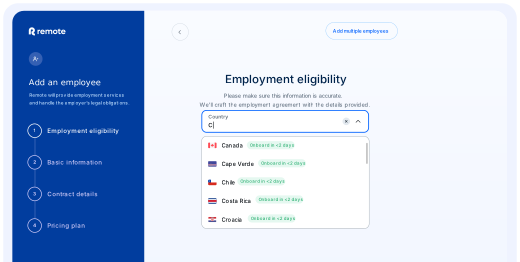
There are many reasons why taking your business global could be the right move, including:
Talent acquisition
One of the principal benefits of expanding internationally is the chance to tap into new talent pools.
Hiring across borders gives you access to new capabilities and perspectives, while enhancing diversity and inclusion. A notable McKinsey study shows diverse teams are 33% more likely to outperform peers.
Hiring international talent can also be more cost-efficient, particularly when roles are remote.
Remote can help you find top talent in overseas markets, and hire, onboard, and manage them quickly and efficiently.
Brand exposure
Expanding internationally raises your profile and credibility in new markets, exposing your brand to a wider audience and building trust that supports recognition and revenue growth.
Happier employees
Global hiring tends to improve employee satisfaction with the remote model and benefits. For example, our Global Benefits Report found 78% of remote workers were more satisfied with their benefits compared with 60% of on-site staff.
This engagement supports retention and agility. In our 2023 Remote Workforce Report, 72% of companies reported increased productivity after adopting a remote, distributed workforce model.
Increased revenue
As noted, global expansion opens new markets and customer segments, unlocking additional revenue. It can also help you outperform competitors—businesses that expand internationally generate an extra 1.9% in annual shareholder returns compared with peers that do not expand.
McKinsey also found firms already enjoying robust domestic growth can secure an additional 2.6% in annual returns through international expansion.
Potential cost savings
Beyond revenue gains, global expansion can lower costs—for example, by entering markets where inputs, materials, or salaries are cheaper.
Localised insight
Entering new markets requires local insight and expertise. Without it, you risk alienating local audiences or partners through avoidable communication errors or cultural missteps, or misjudging business practices that cost time and money.
Hiring local, culturally aware people helps prevent these mistakes. Whether engaging consultants as contractors or appointing a permanent local hire, Remote can help you locate and hire the right person.
“Hiring international employees gives your company a soft landing when entering new markets and allows you to build trust quickly in new places.” Job van der Voort, CEO and co-founder of Remote
Competitive advantage
Entering a market ahead of competitors helps establish brand recognition and credibility. Being first to market can deliver a notable competitive edge.
Even smaller firms can make a substantial impact if they offer the right product or service for the right market.
Market protection
A global footprint lets you capitalise on diverse market trends and customer preferences, helping to diversify revenue streams and hedge against local downturns.
Operating across multiple markets reduces the effect of local recessions: underperformance in one country can be offset by stronger results elsewhere.
This helps preserve overall business stability during macro-economic volatility.
Customer support coverage
If you have many customers in a region or who speak a certain language, expanding enables better localised support.
You can hire support specialists in those markets who speak the language and understand the culture, providing a smoother, scalable service for customers in each country you operate in.
Strategic partnerships and collaborations
Expanding globally provides a platform to form strategic international partnerships and collaborations that might otherwise be out of reach.
Such relationships can drive innovation and open new markets, while boosting operational efficiency through knowledge and technology transfer.
What are the challenges of international expansion?
International expansion brings many benefits, but it is rarely simple. Even when conditions appear favourable, success is not guaranteed—regardless of industry or company size.
The data underlines this: companies that expand overseas often experience a return on assets (ROA) of -1% for up to five years, and only 40% exceed a ROA of 3% or more.
Understanding common pitfalls and how to mitigate them is therefore essential. Below are the principal challenges you are likely to encounter.
Local legislation and regulations
Failing to comply with local labour and tax laws can lead to fines, legal action, and even restrictions on doing business. Navigating foreign legal systems can be complex, time-consuming, and frustrating—especially when regulations change frequently.
That is why partnering with an experienced global HR provider is advisable. Remote helps ensure compliance with labour and tax laws wherever you hire, letting you concentrate on operations and growth.
“Remote provides all the local compliance and regulatory knowledge for each specific country in-house. Without them, we would have to hire an additional 3 or 4 people to be able to cover all the local labor laws, taxes, accounting, translation, and payroll responsibilities.” Mona Walther, Senior People Operations Manager at commercetools
See our Country Explorer tool for all available countries and our roadmaps.
Market differences
Many firms err by simply copying domestic strategies overseas. True international expansion demands a deeper grasp of local dynamics, consumer behaviour, and cultural nuances.
For instance, fintech companies expanding internationally often excel in engineering and product development.
Yet they may lack experience in cross-border go-to-market (GTM) planning, or in selecting appropriate campaigns, channels, and messaging. That is why it is important to hire the right people who know the market well.
Cultural differences
Cultural variance affects communication, negotiation, and people management. A lack of cross-cultural awareness can cause misunderstandings, damaged relationships, and even project failure.
Therefore, hire local staff who understand culture and customs; they provide valuable insights and networks that help you navigate the local business environment.
Competition in foreign markets
Overseas markets are often intensely competitive, with local and international players fighting for share. Knowing the competitive landscape and differentiating your proposition is essential.
Global competition has risen sharply in recent years, so a clear competitive strategy is vital when expanding internationally.
Time and money
International expansion can demand substantial upfront investment, including:
Legal and regulatory compliance
Setting up local operations
Developing distribution networks
You may also need to allocate time and funds to build relationships with local partners and to recruit and train a local workforce.
These costs add up. For example, forming legal entities can take up to 12 months and exceed $100,000 per location, depending on local requirements and ongoing administration.
To avoid these burdens, consider an expansion partner such as Remote. With our EOR services, you can hire in multiple countries without forming a single entity—and you can be operational within days.
To learn how an EOR functions, see our in-depth guide.
Logistical issues
Depending on your offering, logistics—such as transport, supply chain management, and customs—can be major barriers. Moving products across borders requires careful coordination to keep operations efficient.
To deliver products and services reliably, an effective distribution network and resilient infrastructure are essential.
Banking and currencies
International expansion typically involves multiple currencies, banking systems, and financial regulations. You must manage foreign-exchange risk, form banking relationships, and handle international payments.
You will also need to decide how to pay employees and contractors in the new country. Remote simplifies this through our EOR, centralised payroll, or contractor management services.
How to pay your global employees
Global Payroll How to pay international employees
Data regulations
Data laws vary by country and can shape how you store and transfer information across borders, making this a complex aspect of international operations.
It is vital to stay up to date with data regulations to reduce compliance risks and protect your business.
Data security for distributed teams
Data Security & IP [Webinar Recording] IP protection and data security for distributed teams
IP protections
When entering new markets, protecting products, ideas, and branding is critical. Securing patents, trademarks, and copyrights where relevant is essential to safeguard your IP.
You must also plan to prevent IP theft or copying in line with local laws, and be prepared to resolve disputes in local courts if necessary.
Remote can help you protect your IP when working with employees and contractors overseas.
Cybersecurity breaches
Cyber incidents are widespread, and a breach can be extremely costly. IBM reports the average cost of a data breach in the US in 2022 was $9.5 million.
Defending against cyber threats and data leaks is demanding, especially when expanding internationally. Different regions have varying requirements for data protection, and you must keep pace with all of them.
Cross-border data transfers are risky, and securing devices and remote workers adds complexity. Home-working staff may use personal devices, increasing exposure.
Ensure employees are trained in safe online practices and adopt modern tools and procedures to maintain strong cyber defences.
If you choose a global HR partner, verify its security standards. Remote, for example, uses enterprise-grade data protection and security protocols and has a dedicated security team to support clients. Learn more about Remote’s security protocols.
What are the key steps in international expansion?
Having considered the benefits and risks of expansion, what does a practical plan look like?
International expansion is more than planting a flag; it requires market understanding, local relationships, and careful handling of cultural and regulatory differences.
Below is a high-level outline of the steps you might follow—and how Remote can assist.
Take time to thoroughly understand the dynamics of the target territory. Analyse data, conduct assessments, and build a clear picture of consumer behaviour and preferences.
Review market trends and assess growth potential, considering macro-economic and demographic factors.
Anticipate barriers to entry—such as cultural differences, language, and regulatory constraints—so you can prepare solutions or reconsider market entry. Determine your preferred mode of entry, weighing resources and risk tolerance. Each option—exporting, licensing, merging, or direct investment—has distinct pros and cons, so clarify your risk/reward parameters.
For example, exporting is relatively low risk but provides less market control. Licensing may speed market access but could pose quality or brand risks. Be sure to document your plan formally.
After research and entry-choice evaluation, produce an expansion plan that serves as a roadmap and covers key areas such as:
Financial plan : Assess the budget for market entry and ongoing operational costs. Factor in currency exchange and financing options that could affect capital structure and cash flow.
Set realistic revenue and profit forecasts based on market research and prepare for multiple scenarios—optimistic and adverse.
Risk assessment: International operations carry risks from political instability to regulatory and cultural differences. Conduct a detailed assessment of each risk and its potential impact on operations, finances, and reputation.
After identifying risks, create mitigation strategies and contingency plans to keep operations resilient and enable rapid recovery from unforeseen events. With robust risk management, your expansion will be more adaptable and durable.
Infrastructure and logistics plan: Depending on your business, detail infrastructure and logistics needs—both physical and digital.
This may include mapping your supply chain, logistics, and transport processes to ensure smooth operations for all stakeholders.
This phase focuses on preparing to enter the market and typically involves:
Securing final funding commitments
Preparing your digital and/or physical infrastructure
It is critical to understand local employment, IP, tax, and accounting requirements, and the rules for establishing an entity, to avoid fines and reputational harm.
You can hire local legal and tax advisers, but that is time-consuming and costly. Using an EOR such as Remote offers a faster, cheaper way to handle legal requirements.
This enables you to begin hiring the people who will drive expansion within days.
This stage is about establishing a tangible presence in the new market. It may involve opening a local office or hiring local staff and ensuring you have the on-ground resources for effective operations.
You will also begin executing your marketing plan to build brand awareness and attract customers.
Once operational, focus shifts to scaling and increasing your customer base. This period emphasises continuous marketing, customer acquisition, and retention, driven by performance metrics and ROI.
At maturity, your business has an established market presence. The focus becomes ongoing optimisation of operations and refinement of offerings based on customer feedback and trends—requiring continuous effort to remain competitive.
HR considerations when expanding internationally
Building your team
This step is arguably the most decisive factor in whether your expansion succeeds.
“We know that the success or failure of our company is 99% down to our people. So being able to attract and then retain the best talent is vital to our success."
-Antonio Arias, Chief People Officer of QuoIntelligence
When entering a new market, understanding local workforce expectations—salaries, benefits, and labour-law differences such as minimum wage, overtime, and working hours—is crucial and often challenging.
With Remote, you do not need to worry. Our integrated platform supports every stage of the employee lifecycle so you can concentrate on the core business. Here is how it works:
Recruitment
The initial task is finding suitable candidates. Use local job boards, social platforms, and referrals, among other channels.
You can also engage Remote Talent to help fill hard-to-staff roles, with our remote jobs board providing global reach.
Through our EOR service, you can also select and offer the best local benefits, making it simpler to attract top talent.
Hiring
After selecting a candidate and issuing an offer, you can hire them promptly through our EOR service or, for contractors, via our Contractor Management service.
This is particularly helpful in a new market, allowing you to trial independent contractors before committing. We also make it straightforward to convert contractors to employees and help you avoid accidentally misclassify your workers.
“Companies are increasingly recognizing the benefits of tapping into pools of skilled freelancers who can contribute on a project basis, providing the necessary expertise without long-term commitment. Interestingly, this isn’t confined to Western countries, but is becoming a popular source of work for developing nations, too.”
-Pedro Barros, Senior VP and GM for Contractors at Remote
Onboarding
Onboarding is one of the most sensitive sequences in a new hire’s lifecycle. A poor experience can cause doubts and risk losing the new hire.
When you onboard through Remote’s EOR, the new hire receives personalised support and clear guidance through every step. We ensure the process is fast, compliant, and include an assigned HR manager for the employee.
The same applies to contractors: we manage the process compliantly and provide expert assistance throughout.
"With Remote, onboarding contractors is seamless: it literally takes seconds to add new people to the platform, issue their contracts, and request the ID documents necessary for them to get started."
- Erik Sveen, Founder and CEO of HomeProject
Payment
Paying employees and contractors can be secure, simple, and fast. Wherever your workforce is located, Remote streamlines payroll so you can process payments in minutes.
If you use our EOR service, payroll is integrated: we handle calculations, tax deductions, and timely payments, plus in-house support for payroll enquiries. Learn more about EOR payroll management.
If you decide to open your own legal entity, we can also provide payroll as a standalone service. Learn more about Global Payroll.
You can also manage and settle contractor invoices in a few clicks—and across multiple currencies. Learn more about paying independent contractors.
Managing team members
Daily HR management for your international team is straightforward with Remote. We offer a fully free HRIS, allowing you to unify your HR systems and manage everything centrally. Employees can self-serve for common HR tasks like time tracking, expenses, and document access.
"The HRIS platform is easy to use and everything is there right in front of us. It all comes together and we’re not having to update different sources. That helps us be more efficient, which is so important in a scale-up."
-Bas Moeyaert, Loop Earplugs
Scaling
The advantage of expanding with Remote is limitless scalability: our platform and services grow with you around the world. As you add personnel and enter new countries, there is no need to change providers or processes—something not always possible with local vendors.
Whether recruiting, hiring, onboarding, paying, or managing, we can cover every aspect of your global HR—from your first hire to your thousandth and beyond.
Examples of successful international expansion
Remote has supported organisations of various sizes to expand globally, including the following:
Loom
Loom, a major video communications platform, used Remote’s global infrastructure to expand its team across several new countries.
With an extraordinary 900% year-over-year growth in 2021, Loom relied on a global talent pool to meet demand, but international hiring presented many complexities.
With staff spread across 11 countries, Loom’s HR team found local hiring regulations difficult to manage. Creating international hubs and localised management was not feasible.
Remote provided coverage where Loom had employees and entities, offering transparent costs via its EOR. This allowed Loom to convert contractors into employees, giving legitimacy and a better experience for its workforce.
As we continue to scale and go forward, we can now provide employees the opportunity to relocate through Remote and hire great candidates through Remote.
Loom has since accessed a more diverse talent pool while ensuring compliance with local laws, enabling growth and an improved employee experience.
Primer
Primer, a leading fintech firm, leveraged Remote’s infrastructure and expertise to manage the complexities of international hiring.
Recognising the potential of remote work, Primer sought global talent, but expanding across countries posed distinct challenges.
Working with Remote provided Primer with the tools to hire internationally, and Remote’s EOR offered a fair, transparent cost model and ensured compliance so Primer could focus on innovating in fintech.
I wasn't confident with the other EORs that we use, which is a dangerous game, because that puts more stress and pressure on our team to provide the follow-up. One of the biggest things Remote did was create this environment where you became an extension of our team, really followed up and overcommunicated in a lot of ways. That was vital for us, because it alleviated some of that responsibility from our team internally. -Erin Potter, Head of People & Operations at Primer
Primer also converted contractors to full-time employees, improving consistency and the employee experience. As a result, the company successfully expanded its team across borders while maintaining employee satisfaction.
Read more about Primer’s story.
Seatti
Innovative tech company Seatti partnered with Remote to transform its approach to global talent acquisition and management.
Like many firms, Seatti wanted to hire in new markets to support international growth, but global employment complexities presented challenges.
With Remote, what caught our eye is the fact that you have your own legal entities in so many countries around the world. A lot of other similar providers that we looked at often just did it through partnerships. I think the growth and traction of Remote probably also speaks for itself and gives a strong indication that you're doing a lot of things right. -Chris Bieri, Co-founder of Seatti
Remote’s EOR ensured Seatti complied with local laws, allowing it to expand across borders and foster innovation and diversity.
Read more about Seatti’s story.
Effortless HR Anywhere: Take the Tour
Seamlessly manage your workforce, from first hire to final paycheck
Expand internationally with Remote
As illustrated, international expansion offers many opportunities but also presents numerous challenges.
Remote’s integrated global HR solution is designed to support you through these challenges. We help you consolidate operations and expand by hiring, managing, and paying local talent while ensuring compliance with evolving labour and tax laws.
Whether you need one employee or contractor abroad or hundreds across multiple countries, we offer everything in a single, streamlined platform. Our local teams are on hand whenever you need advice.
To learn more about our platform and how it can help you expand your business, book a demo or speak to one of our friendly experts today.