
Guide to employee retention: how to keep your best talent
No business can grow if the people growing it don’t stick around
In this guide, we’ll provide practical advice and tactical insight, designed to help business leaders make a real and lasting impact on employee retention rates. We want to give you the practical advice you need, not just to retain your best performers – but to sustain their motivation and productivity for years into the future. We’ll be looking at how you create a strong and supportive remote work culture and at the localised benefits that help you to protect talent from competitor poaching. We’ll also introduce the guiding principles of successful, sustainable remote teams:
- Flexible and asynchronous work
- Communication and documentation
- Connexion and belonging

Why does retention rate matter?
Retaining people — and implementing programs to measure and support that retention — is non-negotiable if you want your business to grow and thrive. In the era of remote work, many companies are struggling to identify what makes them unique, and as a result, what makes them the best place to be for current and future employees.
Employee turnover has risen 8.7% since 2019.
By maintaining a strong retention rate, you’ll enjoy:
And, ultimately, a massive boost to your bottom line. Building a business with a great retention rate inevitably means building a business that can weather any storm and grow in any economic climate. When good people want to work for you, there’s nothing you can’t do.
Increased productivity
Better customer experiences
Reduced recruitment and onboarding costs
Improved team morale
Great word-of-mouth about working for your company
Remote
Amanda Day
In a world in which we always strive to be more inclusive, being intentional about including all genders, parental leave covers all aspects of becoming a parent, without referencing a specific gender. It also implies that any parent with a child under the age of one can take parental leave, without making assumptions of who will be taking care of the child. The flexibility and choice matters most to employees.
Frequently Asked Questions
How do you calculate your retention rate?
Before you can improve retention rates, you need to know what your retention rate is today.
To calculate your retention rate, first decide the time period you want to assess. For example, you could look at the past year or the past quarter. You then need to find two numbers:
The number of employees you had at the start of the time period
The number of employees you have at the end of the time period (minus any new hires)
Next, perform the following calculation to find your staff retention rate:
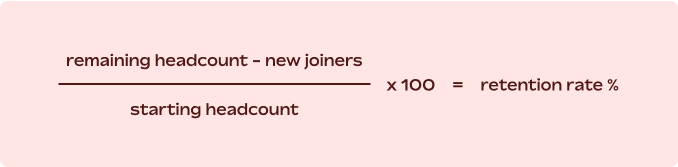
So, for example, you started a quarter with 162 employees and ended that quarter with 170 employees, 20 of whom were new hires, your equation would look like this:
((170-20) ÷ 162) × 100 = 92.56%
You need to remove any new headcount so you don’t accidentally overstate your retention. If you have 100 employees and add five new ones with no departures in three months, for example, your retention rate would be 105%. By subtracting any new hires from your retention rate calculations, you can get a more accurate reading.
When measuring longer periods of time, it’s possible that some people will join and leave the company within the time frame you want to measure. In these cases, you can calculate a separate figure for new hire retention, using new hires added and new hires remaining. So, if you hire 20 people in three months and one leaves, your new hire equation would look like this:
((20-1) ÷ 20) × 100 = 95%
Generally, retention rates over 90% are considered good. For new hires only, you would want to see that number at 95% or higher, as you would expect new hires not to leave within just a few months.
The roles with the highest turnover rates are Product (36.4%), Information Technology (36%), and Engineering (35.2%).
Employee Retention Tactic:
Try calculating retention rates for your in-office teams and remote teams separately. If you find a difference, it may be because your remote workers don’t feel as supported as their in-office peers.
Why does top talent choose to leave?
Bear in mind though that rates vary from industry to industry: retail, tech and media, professional services, entertainment, and accommodation have lower-than-average employee retention rates. So if your business sits within these sectors, your ideal retention rate might be a little lower than the global standard.
If your staff retention rate isn’t what you’d like it to be, you may be wondering why employees are choosing to leave.
McKinsey’s 2022 Great Attrition, Great Attraction Survey 2.0 provides valuable insight. According to this survey, the primary reasons employees give for quitting their jobs are ranked as follows:
Lack of career development and advancement
Inadequate total compensation
Uncaring and uninspiring leaders
Lack of meaningful work
Unsustainable work expectations
Unreliable and unsupportive colleagues
Lack of workplace flexibility
Lack of health and wellbeing supportA non-inclusive and unwelcoming community
Tackling these issues within your own organization is essential if you are to reap the benefits of good remote retention rates. With these reasons in mind, let’s examine the best ways to boost retention at your business.
The role of equitable global compensation in staff retention
Staff are more likely to stick with your company if they feel valued and fairly treated. As evidence and common sense both suggest, providing equitable compensation is perhaps the most straightforward way to get started.
Why is equitable compensation so important?
When employees feel that they are compensated fairly for their work — in relation to their skills and in comparison to the remuneration received by their colleagues — they tend to be happier and more motivated.
Equitable compensation is really one of the cornerstones when it comes to retention in any organization. An equitable compensation philosophy instills trust and confidence in employees, who in turn feel incentivized to perform better and remain with a company.
Compensating your team members appropriately is essential, but making those calculations can get difficult. To make sure you’re getting it right, check out our guide to remote worker compensation.
Remote & Async Work

Developing an equitable compensation package for your employees
You need to consider more than an employee’s skill and seniority level when deciding what a fair compensation package looks like. If your employees work in different countries, there are lots of factors involved. Consider the following on a country-specific level:
Mandatory employer-provided benefits
The cost of living (and what that means for salary expectations)
Mandatory salary deductions
Employee expectations with regards salary and benefits
By taking all of the above into account, you can develop a total rewards policy — that is, a compensation package with value and fairness baked in. Your total rewards policy takes into account the bonuses, benefits, and additional incentives that you offer to employees.
Remember that equitable compensation is a powerful mechanism.
Modern professionals expect to be able to impact the success of their company and see a real-world return. Today’s best compensation strategies are future-thinking where employee success is intrinsically connected to company success. Bob has found that compensation has to go well beyond a market-rate salary to be a competitive advantage. A progressive approach to compensation can be distilled down into six essential components that include salary, bonuses, pension, and equity, but also, and equally important, “professional” benefits and “lifestyle” benefits. Designing the perfect compensation cocktail can get complicated, so it’s crucial to lean on modern HR tech tools to help validate the impact of chosen strategies on candidates, team members, and leadership.
Annie Rosencrans, U.S. People & Culture Director @ HiBob
When your compensation strategy ticks all the boxes for your employees, you’ll motivate staff and promote long-term engagement with your company.
Want an easy-to-follow guide to calculating global compensation?
Check out our webinar on the topic: Calculating Global Compensation
How to construct a benefits program to retain top global talent
Companies that allow employees to work remotely have lower turnover rates than office-only companies. Remote’s research found this difference is estimated to grow to 4.4% in 2023.
If you want to attract and retain a global team, you must offer a locally customized, globally competitive benefits plan.
While it’s easy to fall into a ‘one size fits all’ trap, offering all employees the same benefits package wherever they are in the world, it’s very unlikely that this solution will address their needs. Benefits design should account for local needs and cultural differences as much as possible. This doesn’t just enable you to attract top talent. The best benefits programs are critical for talent retention. Joana Viana, Senior Global Benefits Design & Strategy Expert
To customize benefits packages and compete with local employers who know the local workforce inside and out, you need in-depth local insight.
Let’s look at an example:
In the UK
Offer a medical plan with maternity cover to your employees in the UK, and they’re unlikely to be wowed by the prospect. That’s because they already have access to free healthcare, including maternity care, through the National Health Service (NHS).
In Singapore
Offer a medical plan with maternity cover to employees in Singapore, however, and it is much more likely to affect their opinion of an employer. In Singapore, maternity healthcare can end up costing thousands of dollars, so anyone considering parenthood would feel reassured to have this type of cover as part of their benefits package.
When it comes to benefits, nothing beats local insight. However, gathering this information yourself can be tricky and time-consuming. That’s why we created the Global Benefits Report. This resource helps businesses quickly and easily compare preferred benefits across countries and continents.
Want a little extra help with your global benefits strategy?
Here at Remote, we give businesses access to local benefits experts, so you know exactly which benefits you legally have to offer and which are optional extras. We also offer curated benefits plans for every country around the world, saving companies the time and money involved in doing the legwork for themselves.
"Remote helped us build loyalty with employees by providing world-class benefits and the rights that come with being employed locally." Heather Miki, People Operations Manager @ kWh Analytics
"We wanted to quickly grow our Mexico presence without navigating the intricacies of incorporation, payroll, and benefits management ourselves. Remote allowed us to do exactly that." Greg Kefer,CMO @ Lifelink Systems
Build a remote-first culture to manage global teams effectively
Remote-first companies are not just for remote workers. It may sound strange, but it’s true. But adopting remote-first practices, you create a more equal working environment for everyone, regardless of where they work. Leaning into documentation, asynchronous work practices, and a culture that values results over hours is better for all. Let’s take a look at how to create a remote-first environment of your own.
How to reduce employee turnover with a strong talent retention strategy
What do we mean by remote-first?
Remote-first means that remote work is seen as the default. For employees based at your HQ and employees who have never even set foot in your office, the experience of working for your company should be the same.
Remote-first culture | In a truly remote-first culture, all elements of the employee experience — from manager support to team bonding to progression opportunities to workplace tools — are accessible to all members of your team, regardless of their location. |
Building a culture isn’t just about what happens outside of work. It’s also about how the work happens. We’ve put together a guide on how to build a strong and supportive remote culture to help walk you through it. What needs to change to go remote-first?
As many team leaders have experienced, transitioning from an office-based to a remote-first model is not without its challenges. If you try to replicate an office environment in a remote setting, you’ll only half-succeed.
Not everyone can stop by a colleague’s desk for a project update or chat with people about ongoing projects on the way to the parking lot. Missing out on those simple, everyday interactions can leave remote employees feeling disconnected, overworked, and ineffective. This issue is sometimes compounded by the common (but avoidable) mistakes that new remote managers tend to make:
Common remote leadership mistakes to avoid
If you fail to communicate publicly and often, employees may feel disconnected from the group’s larger goals.
If you don’t respect employee downtime and make requests of people who are off the clock, your team members may burn out.
If you don’t set a good example of life-work balance, your employees may feel pressured to work long hours and suffer accordingly.
If you micromanage by checking in or using time trackers to reassure yourself that your team is on task, you will drive away good workers.
If you fail to use communication tools effectively, like by sending direct messages instead of posting in public channels, messages will get mixed and people will feel left out.
Making these mistakes can create a negative employee experience and take away from the success of your employee retention programs.
Regular employee surveys and exit interviews can help senior management determine — and, if necessary, improve — overall employee job satisfaction. And this reduces turnover.
The problem with micromanagement
Micromanagement is a common remote work problem. Many employers have felt a little nervous about handing over workday autonomy to their employees.
This means that some organizations have chosen to implement tracking tools on team members’ computers, in a bid to keep tabs on their productivity. The result, however, is that experienced employees don’t feel trusted.
This can breed resentment and lead to a breakdown in mutual respect. It also encourages key employees to meet the bare minimum level of productivity required.
So, what should remote-first managers be doing differently?
Judge employees by their productivity and effectiveness, not by the number of hours worked.
Essential elements of a remote-first culture
Now we know what remote-first culture doesn’t look like, what are the fundamentals leaders need to put in place to make a success of remote working?
Communication
Intentional communication with regards to progress, performance, and recognition is essentiall
Asynchronous work
A process through which team members can work productively and connectedly in any time zone and at any time of day.
Documentation
Every employee contributes to a culture of documentation, where important information is captured, logged, and shared with the entire team.
Connexion
Channels for non-work related chat help teams to get to know each other better.
A closer look at asynchronous work Asynchronous work: a working practice that doesn’t require members of a team to be online at the same time. Asynchronous working, or async, is essential to a high-performing remote team. Working async enables team members to work productively — with access to all necessary resources — no matter when they log on to work. This helps them to maintain work-life balance and enjoy the benefits of flexible working. Asynchronous working is also a valuable retention tool for employers. Employees value flexibility, trust, and understanding. A culture based around asynchronous working shows that your organization is committed to providing all three, which can help boost retention. Unsure whether asynchronous working is right for your business? Learn more in this guide to async work from Remote COO and CTO Marcelo Lebre.
How supportive remote-first management boosts retention
Cultural change is only possible when you have forward-thinking managers willing to adapt to a new status quo. For remote teams to function well, a remote-first culture needs supportive remote-first managers What does supportive remote-first management look like? Great remote-first managers treat their teams with respect and trust while insisting on accountability. They don’t care when their team members are online, as long as everyone is present for necessary meetings and attends to the needs of customers. They don’t care which hours people work, but they do care that documentation is always updated and that updates are regularly shared within the proper groups. They use 1:1 meetings to connect, get employee feedback, and develop culture instead of walking through to-do lists.
Remote-first organizations are not about removing responsibility. If anything, people who work remotely have to be even more responsible than people who work in offices. But if you hire great people and trust them from day one, they will reward you by doing great work at impressive speed. Job van der Voort CEO of Remote
Being a great remote-first manager isn’t about following a set of specific rules. Instead, it’s about saying, “I trust you,” then having that trust rewarded when team members deliver on their goals and provide clear, public updates on their work.
Effective employee retention strategies for every business
The modern workplace is changing, so focusing on strong employee retention strategies is crucial. Whether your team works remotely, in an office, or in a hybrid setting, keeping talent is essential for a solid company culture and high employee engagement.
The following retention ideas for employees can help make this happen for you.
1. Foster career development
Giving your employees clear career paths and growth opportunities is important for retaining them. Not only that, but mentorship programs and regular reviews can greatly boost employee job satisfaction. Highlight these things during the hiring process to help you attract top talent more easily.
Career advancement opportunities also boost job satisfaction, especially when combined with employee recognition programs. These build employee loyalty by showing employees that they’re valued and have real opportunities for growth in your company.
2. Create meaningful work
Employee satisfaction comes from meaningful work. Getting your employees involved in projects that match their interests and align with the company’s goals helps boost their chances of staying in the long run. Plus, you can start learning about those interests right away during the onboarding phase.
Seeing their work make a real difference not only improves the employee experience but also builds a stronger and more inclusive workplace culture — one where employees feel they are a vital part of the company’s success.
3. Set realistic work expectations
Maintaining a balanced workload is key to keeping employee morale up and avoiding burnout. Offering flexible work options and setting realistic goals helps maintain a healthy work-life balance. Encouraging vacation time and providing the right resources also play a big part in this balance.
Doing these things respects an employee’s personal life, which is good for their overall happiness and job satisfaction. When we set fair expectations, employees become more involved and effective. This leads to a better employee retention rate and less unwanted turnover.
4. Cultivate a supportive team environment
By creating a supportive team atmosphere with team-building activities and open communication, you build a strong culture that boosts employee morale and engagement.
This kind of environment not only makes the workplace culture stronger but also increases employee loyalty and job satisfaction. If your employees feel they are part of a strong and inclusive culture, they’re more likely to stick around. And this means a lower employee turnover rate. All this adds up to a team that feels united and valued.
5. Prioritize health and well-being
Supporting your employees’ physical and mental health should be another key part of your retention strategy. Wellness offerings and remote work options, for instance, can show you actually care about employee well-being. These things help employees maintain a good balance between their work and personal lives, leading to satisfied, happy, and motivated individuals — and lower turnover.
In short, these kinds of employee retention strategies are really important for creating a positive company culture and making sure employees stick around.
Replacing staff costs 43% more
Job van der VoortIn the U.S., it costs about 43.7% of an employee’s pay to replace that employee with a new hire. The most skilled and experienced employees have plentiful options, so businesses looking to attract and retain those workers need to provide them with the flexibility they crave. And that means creating management practices that nurture an environment where flexibility can flourish
Why remote-first management is so powerful
Employees today value flexibility above all else. In the Remote Global Benefits Report, we found that workers around the world want flexibility in their workdays more than they want any other benefit, including four-day workweeks and retirement plans.
What does that mean for managers of remote teams?
Employees today are looking for workplaces where they can fit their work into their lives, not the other way around. They still want to do great work for great companies, but they are no longer willing to put their lives on hold in the process.
Prioritize diversity, equity, and inclusion to keep employees connected
Employees increasingly want to work within diverse, equitable, and inclusive organizations. Remote-first organizations are uniquely positioned to accelerate the adoption of better DEI practices.
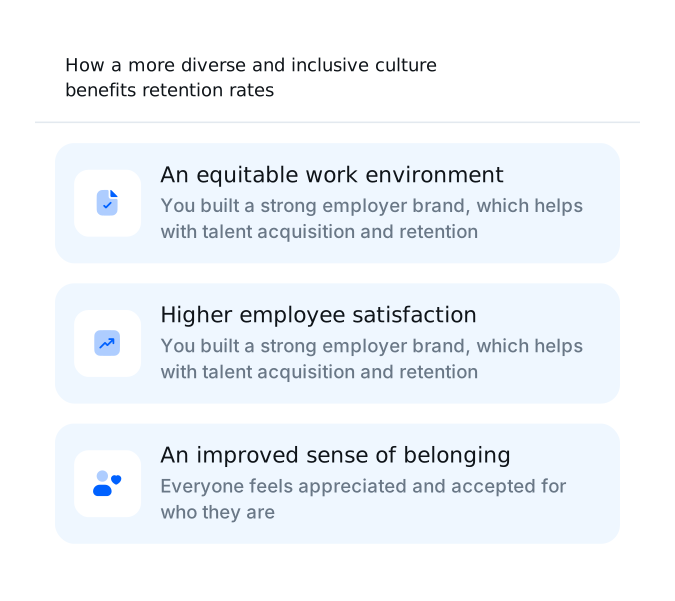
How a more diverse and inclusive culture benefits retention rates
DEI (Diversity, Equity, and Inclusion) is one of the most powerful multipliers for employee retention. By building DEI into your organizational culture, you get:
How to develop a diverse, equitable, and inclusive global workforce
Developing a diverse, equitable, and inclusive global workforce requires real and sustained commitment.
Create a remote DEI committee to help you understand your challenges and opportunities.
Solicit honest opinions on your DEI performance from your team.
Create a formal DEI policy, updating it regularly in collaboration with all team members.
Build DEI into your recruitment strategy by employing inclusive hiring practices.
Support inclusion of underrepresented groups, including women, ethnic minority, LGBTQ, and neurodivergent employees
Want to become a globally inclusive employer? Get up to speed with the help of our webinar: Building a globally inclusive recruitment strategy.
5 pillars to motivate and retain a high-performing remote team
When a team feels motivated and productive, they feel much happier logging onto work each day. It is important that leaders strive to maintain motivation and performance levels across their global team. This means nurturing the employee experience, from recruitment through onboarding and beyond.
Intelligent recruitment
Get off on the right foot by employing valued-based, remote-first recruitment practices.
Communicate clearly and transparently
Adapt the interview process to fit candidate time zones
Share insights into what a remote-first culture is like for employees
These practices will help you to find talented employees who share your values, gel with your team, and understand what to expect as a member of your workplace.
Seamless communication
Good communication and employee experience go hand in hand. To maximize your communication, follow our communication guidelines for remote teams:
Prevent notification burnout. Encourage employees to turn off notifications when they need to concentrate on the task at hand.
Make updates transparent and searchable. Document important meetings and progress reports, then save these documents publicly so they’re accessible to all employees.
Establish communication norms. Ensure employees know communication best practice for all of the communication platforms your company uses.
Never sacrifice 1-1s. Get to know your employees and give them space to raise issues by regularly scheduling one on one calls.
Comprehensive onboarding
Onboarding is another lever for remote-worker retention.
Employee turnover can be as high as 50% in the first 18 months of employment. To avoid being part of this statistic, the ideal remote onboarding program includes:
Engaging, self-serve resources
Assigned onboarding buddies
Introduction to company values and culture
Info on company communication norms
Expectations and targets for their first weeks at work
Regular manager check-ins
Opportunities for progression and clearly communicated career paths are the most effective way to improve retention (63%) — even above increasing salaries!
Smart meetings
Meetings can be highly disruptive. Too many meetings will decrease employee productivity without always providing value. What’s more, poor meeting formats can leave employees feeling frustrated and bored.
So what can you do about it? Perhaps you need to rethink the way you do meetings as a remote-first organization. Here are our tips:
Create an agenda, then cancel the meeting if it can be addressed async
Set shorter time limits to keep things productive and fast
Rotate essential calls to suit different employee time zones
Make it acceptable for people who are not active contributors to leave meetings
Schedule time for bonding and fun facetime to keep work meetings shorter and less frequent
Run remote meetings with these tips in mind, and they’ll become effective forums for communication rather than a drain on your employees’ time.
Supportive management
When you are not spending face-to-face time with your team, it is hard to recognize signs of stress and burnout. Managers of remote teams in particular should be keenly aware of how quickly burnout can affect teams and work to prevent it.
That might mean:
Keeping up-to-date with employee workloads
Creating realistic deadlines
Making time for team activities that aren’t related to work
Encouraging employees to take breaks and book vacations
Modeling good work-life balance so employees don’t feel pressure not to take breaks
Support employees to keep them from burning out, and not only will they be more productive, but they will be more likely to stay with your company for longer.
How flexible work practices can help you retain top global talent
Employees love flexibility, remote work, asynchronous hours, and freedom. If you run your operations with a remote-first mindset, you can provide employees with all of those things while reaching new heights on productivity, responsiveness to customer needs, and accountability.
Flexible working: a top priority for remote workers
Flexible working — the freedom to work where, how, and when you choose — is a top consideration for a large proportion of employees.
Remote’s Global Benefits Report found flexible working to be important for everyone, but especially so for women and young workers. Women often hold more responsibilities at home and with their families, which means flexibility can be a lifesaver as they juggle more responsibilities. Young people tend to be more mobile, which means flexibility can help them design the lives they want while growing with your organization.
Our Global Benefits Report underlined the importance of flexible working conditions for those working in remote roles and globally distributed teams.
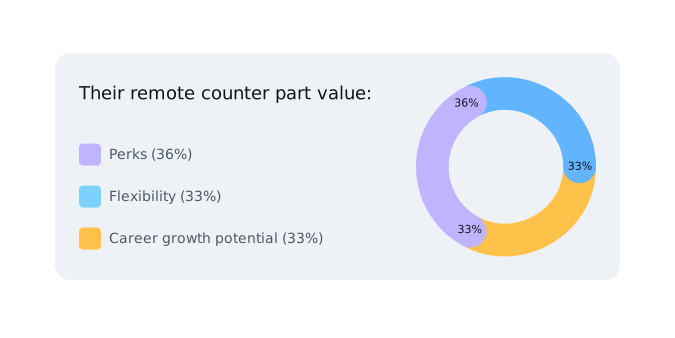
This data shouldn’t just inform your recruitment strategy and compensation structure.
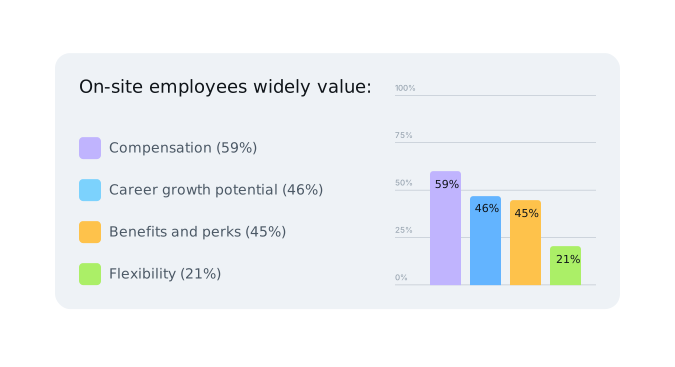
You need to proactively adapt and consider how you can prevent your best team members from seeking another role. Find out what your top performers value most and make proactive improvements internally to boost retention and demonstrate care and loyalty to your team.
Offering clearer paths to promotion, performance-based compensation increases, and more flexible working conditions to retain your best talent will almost always be less cost and time intensive than the alternative of losing key team members and being forced into recruiting replacements.
Flexible work is top priority for 29% of employees
But flexibility isn’t just for a few people: it’s for everyone.
More flexible companies are better able to adapt to hard times and better able to take advantage of new opportunities. The question is, how can you offer the flexibility employees need? For a sizeable proportion of these groups, the opportunity to work flexibly could make or break their decision on where to work and whether or not to stay in their current role. The ability to work flexibly (where and how they want) is a top consideration for 29% of employees overall, but that figure is higher among several key subgroups within the labor market, including: Contractors 38% it’s their #1 consideration overall; Gen Z employees 35% it’s their #3 consideration overall; Women 32% it’s their #4 consideration overall
Offer work conditions that top talent is seeking
69% of employers believe they currently offer flexible working benefits, but only 47% of employees say they’re receiving them.
There is something of a mismatch between the flexibility employees crave and the flexibility organizations are providing. Why is that? Perhaps leaders have a different definition of flexibility than employees. Or, perhaps senior leaders receive a different experience at their companies and are therefore disconnected from the average employee experience. Whatever the case may be, employees are looking for more flexibility at work, and employers need to offer that flexibility or get left behind. This perception gap explains growing dissatisfaction among many employees that is leading to increased employee turnover rates. The knock-on effect is likely a group of disillusioned employers whose efforts and investments in more flexible conditions are not being recognized.
Hidden retention benefits of offering autonomy
Autonomy is a key driver of employee happiness in the workplace, as is trust. So how do you base your culture around autonomy and trust?
It comes down to a combination of transparency, great communication, and meaningful support. This type of work culture creates a sense of psychological safety, ensuring employees feel confident in their roles and able to do their very best work.
How to improve your flexible working benefits
Flexible working shouldn’t mean sacrificing team cohesion or career progression opportunities. If remote workers enjoy flexibility while others receive raises and promotions, they will feel punished for their work choices and may look elsewhere.
In comparison, 45% of on-site employees see telecommuting as a top-tier essential perk (ranking almost as important as core benefits like health insurance and paid holidays). The takeout for global employers is clear. As long as top global talent are happy with an employer’s flexible work conditions, they tend to be satisfied with their overall benefits and perks package.
So, how can your company stand out as a go-to destination for both flexibility and productivity?
Remote, for instance, makes its entire company handbook publicly accessible.
Walk the walk
Leaders should be public about taking PTO and following “nonlinear workdays” so employees feel encouraged to do the same.
Judge results and not hours
At performance review time, base employee grades on how well they did, not how many hours they were online.
Lean into public channels and documentation
No one is too senior to document work, meetings, and plans!
Set a minimum PTO instead of a maximum
Unlimited PTO can carry a stigma, but setting a minimum number can encourage employees to use more days and avoid burnout.
The cost-saving benefit of a flexible working offer
As well as giving employees a top priority perk, flexible working may also give you more flexibility when it comes to your global compensation package.
Remote workers value telecommuting as a top-tier essential perk — one that’s nearly as important as core benefits like health insurance and paid holidays. So as long as their need for remote work is being met, they tend to be satisfied with their overall benefits and perks package. Rhiannon Payne,Remote Work Advocate
For many remote employees, working remotely is the benefit or perk they most desire, so they’re less critical towards the rest of an employer’s compensation package.
Only 36% of remote employees name benefits and perks as one of their most important considerations when evaluating a job offer. In comparison, 45% of on-site employees see telecommuting as a top-tier essential perk (ranking almost as important as core benefits like health insurance and paid holidays).
The takeout for global employers is clear. As long as top global talent are happy with an employer’s flexible work conditions, they tend to be satisfied with their overall benefits and perks package.
Find out what the experts say about managing a global benefits plan by watching Remote’s on-demand global benefits webinar.
You should be able to trust your employees from the first day. If you can’t do that, then why did you hire them? Providing trust early and measuring results instead of hours allows you to create an amazing work environment for 99% of people from the start while allowing you to identify anyone taking advantage of that freedom in bad faith very quickly. Job van der Voort,CEO of Remote
How to foster transparency and trust for remote and global teams
Remote teams work best when everyone knows what’s happening. The best way to create that cohesion is through transparency, which comes before, during, and after the work is performed.
Create clear project outlines and set expectations
If anyone wants to know the latest on a project, they should be able to visit the public documentation to see for themselves. And, if they want to see how something is performing, that data should be available as well.
Let employees design their workdays
Some people are night owls. Others prefer to work early. Some people work all day in short bursts, saving their energy for the times that suit them best. As long as everyone documents and communicates, everything works in harmony.
Record, write, and inform
Keep everyone, in every time zone, up to speed by recording videos of meetings and writing regular updates in public places, like open Slack channels. Tag people frequently and create a culture where people can read notifications when they choose instead of constantly staying glued to the screen.
Communicate in public forums
Communication should be transparent, searchable, available, and accessible. Instead of sending a direct message, write in a public Slack channel or Notion page and tag the person you want to talk to. This way, anyone who wants to be informed about the project can see the public information easily.
Build connections by using face time to bond
Why spend valuable time together doing work you could do asynchronously? Of course, you should always provide space for team members to share their problems, challenges, and feedback in a psychologically safe space. Otherwise, you should use 1:1 meetings and team time to bond, play games, and catch up. Save the hard work for documentation, which allows people to collaborate without having to be online at the same time.
Demonstrate respect
Respect time zones, preferred working hours, and remote work feedback from employees. Stay open to improvements and iterations. Responsive leaders make all team members feel empowered to deliver their best while maintaining strong life-work balance.
Start implementing these retention tactics to keep star performers
Retaining remote talent in the current climate is not without its challenges, but we hope this guide has provided you with plenty of actionable advice.
With this guide at your hands, you now know:
Why remote staff retention is important
How to calculate your staff retention rate
What makes a remote employee want to stay at your company
Actionable tactics to improve retention for your remote workforce
The tips in this guide will help you, but there’s always more to learn! If you’re hiring globally, you can always contact Remote to make it easy to onboard, pay, and manage your remote workforce. We can even help you to prepare and structure competitive offers in new places, so your global compensation plan is always effective and compliant.