.png?branch=production&width=3840&quality=90&auto=webp&disable=upscale)
2024 state of payroll report: uncovering the hidden costs of payroll mistakes
Discover the forces shaping payroll's future through insights from over 2,500 professionals and 1,300 HR decision-makers worldwide. Download the complete report to learn practical approaches that make payroll work for you. Inside, you will find:
- The most frequent payroll mistakes and how to avoid these risks
- How payroll errors affect productivity, morale, and even staff retention
- Advice on moving payroll into a strategic business function
Download now · research: impact of payroll mistakes
Download now
From missed pay to the wrong amount, many people will have dealt with a payroll error at some point. But what are the real consequences for those affected?
A payroll problem is rarely just a small inconvenience for a worker — it can have tangible consequences for their finances, disrupt planned payments and family arrangements, and even limit their ability to socialise. Beyond the financial fallout, payroll errors can also significantly undermine an employee’s morale and mental wellbeing.
As Jonathan Goldsmith, Remote’s VP of Payroll, explains, “Pay is about life as much as it is about work. When wages are processed incorrectly, people can struggle to support themselves and their families. It can disrupt holiday plans or prevent saving for things like tuition or a future home.”
Payroll issues cover any problem or inconsistency within the payroll workflow, such as incorrect pay calculations, worker misclassification, or mismatches in tax subsidies.
At Remote, we regard payroll as more than an administrative task — it is a core HR function for organisations of every size and central to building trust, sustaining morale, and motivating teams. Errors and a lack of transparency around payroll can create uncertainty, increase stress, and damage relations between employers and their employees.
To assess the state of global payroll and measure the real-world impact payroll problems have on workers worldwide, we surveyed more than 2,500 professionals across a range of demographics and industries in the UK, US, and Germany, and canvassed more than 1,300 HR decision-makers responsible for payroll.
In what ways do payroll issues truly influence employers and their employees? Let’s explore the data.
Our survey highlights the critical need for accuracy and openness, and demonstrates the substantial effects payroll errors can have on both staff and employers. Payroll inefficiencies can strain relationships and create significant operational chokepoints.
"Payroll is a fundamental HR responsibility and must centre on people. Maintaining this focus is essential to prevent an erosion of trust and to preserve a company’s reputation among employees." - Jonathan Goldsmith, VP of Payroll at Remote
More than half of employees report payroll problems
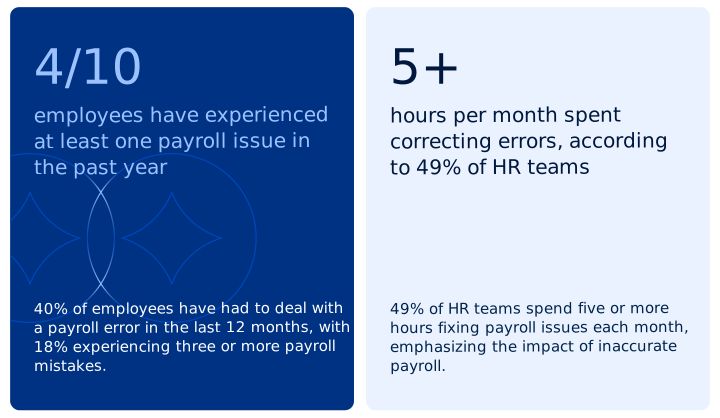
Fifty‑three percent of surveyed employees reported experiencing a payroll issue during their career, and half of those had at least one incident within two years of the survey. Forty percent saw an error in the past year, and almost 11% faced a mistake in the last month.
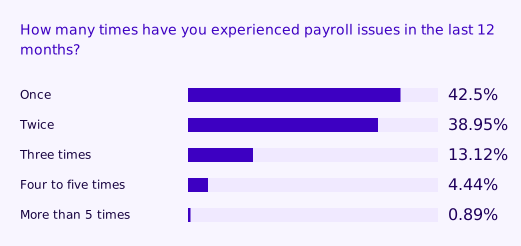
Among respondents who experienced a payroll error in the past year, 43% encountered an issue only once, while more than 18% reported at least three payroll mistakes over a single year — with the highest frequency of errors reported by younger workers (aged 16–24).
Although our survey of HR decision-makers found that 7 in 10 organisations (71%) who outsource payroll reported improved accuracy, employers should not assume perfect precision — indeed, almost half (49%) of HR teams spend five or more hours each month resolving pay-related issues, particularly within larger organisations.
Who is most likely to encounter a payroll error?
Younger employees face a higher risk of payroll errors. Over 70% of 16–24-year-olds surveyed reported a payroll error in the past two years, compared with just 30% of those aged 55 and over. Although Gen Z workers are less likely to review their payslips (47% don’t check them every month), this greater error rate may reflect lower job stability — younger employees generally change roles more often, for example.
Payroll errors occur more often in US workplaces. US employees are 26% more likely to experience a payroll error than their UK counterparts, and a quarter of workers in America reported a payroll issue in the last three months. A higher payslip frequency — most Americans are paid every two weeks — along with the well-known complex US tax system may be contributing factors.
Remote workers are less likely to encounter payroll issues. Perhaps counterintuitively, fewer fully remote employees (17%) reported a payroll error in the past three months than those in hybrid or fully in-person roles (both 22%). While fully remote staff check their payslips less often (41% don’t check them every month, versus 31% of in-person workers), it may also be that fully remote companies, by necessity, operate with stricter and more dependable payroll processes.
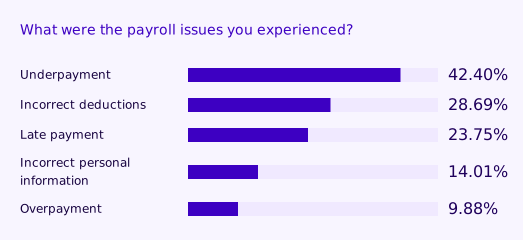
The survey also found that underpayment is the most common payroll issue. Of those who’d experienced a payroll error, 42% reported being underpaid, while almost a quarter (24%) received a late payment. Overpayment accounted for about 1 in 10 cases.
In the case of late payment, the majority of issues are resolved within a week (60% of those who reported a late payment said their wages arrived within seven days), but some employees waited longer — around 18% were left waiting for more than two weeks, and almost 7% experienced delays of one month or more.
Read the full report to discover approaches for reducing payroll errors
How do payroll mistakes affect employees and your organisation? Get the State of Payroll Report for a detailed look at their impact and practical guidance to minimise your risk.
Stress and anxiety are the primary consequences of payroll mistakes
Among the 53% of employees who had experienced at least one payroll error, nearly a quarter (24%) cited delayed payment as one of the problems they faced.
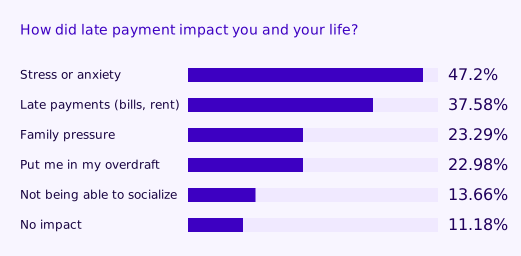
Participants said the top personal impact of late pay was “stress and anxiety” (47%). “Family pressure” ranked third (23%), underlining that the emotional fallout from delayed wages can match the financial harm.
Financial strain is also widespread. Almost two-thirds of respondents said late payslips forced them to make late payments for banknotes and rent, or put them into their overdraft.
"Payroll affects people, and it’s an emotional thing. It has a significant impact on the morale of the employees in the organisation. After all, if an employee doesn’t get paid correctly, or they don’t get the pay they expect, this could result in them missing a medical payment or something equally as vital.” - Jonathan Goldsmith, VP of Payroll at Remote
By contrast, our survey of HR decision-makers found that, while 95% of employers acknowledge payroll discrepancies affect employees, fewer than a quarter (24%) believe the impact is significant. A larger portion (30%) think payroll issues have a small or no impact, highlighting a potential gap between employees’ experiences and HR leaders’ perceptions.significant impact. A greater number (30%) feel they have either a small impact or no impact at all — highlighting a potential disconnect in the perceived impact of payroll issues between employees and HR leaders.
Who is most affected by payroll mistakes?
Women are more prone to payroll-related anxiety. Female employees feel the emotional effects of payroll errors more intensely than their male counterparts, with over half (52%) of women reporting stress and anxiety from a late payment, compared to 42% of men.
Younger generations are more susceptible to stress from late payments. Employees aged 55+ report the lowest levels of emotional impact from payroll mistakes (just 25% affected), whereas more than half (53%) of those in the 35–44 age range report stress or anxiety — possibly reflecting greater financial and family responsibilities.
Employees in the US report higher anxiety about payroll mistakes. While American workers not only face payroll issues more often, they also report higher stress or anxiety following an error. 56% of US employees said they felt high levels of stress caused by a late payment, compared to 35% of the UK workforce.
Remote workers report greater stress related to delayed payments. Possibly because they can feel isolated when problems arise, two-thirds (66%) of remote employees say delayed wage payments have caused them stress. This compares with 51% of hybrid workers and 44% of in-house employees.
Payroll errors can affect employee-employer relations
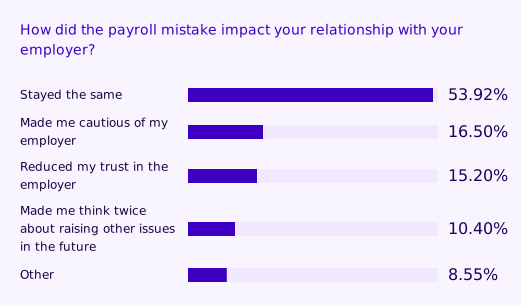
Payroll mistakes can also undermine the employer–employee relationship, as a discrepancy frequently erodes trust. While over half of employees reported no change in their relationship after a payroll problem, 42% said it worsened.
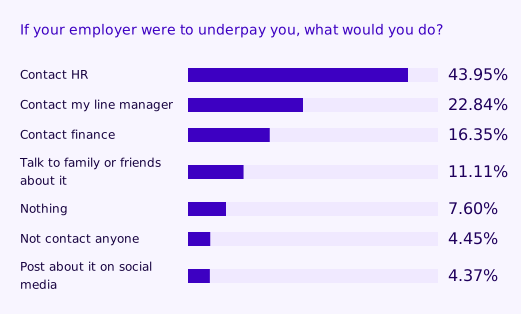
There is also reputational risk when payroll errors occur. When employees were asked how they would react to being underpaid due to a payroll mistake, just over one-fifth (21%) said they would either “make a complaint” or “post about it on social media,” which could have wider repercussions for the business.
“There are functions within a company like payroll that work for the employee, and they need to remember that and own the impact. The after-effects of poorly running payroll to a business are factors like retention, sentiment, and motivation — those are really big things.” - Jonathan Goldsmith, VP of Payroll at Remote
Our survey of HR decision-makers shows a possible misalignment: almost 24% prioritised faster payments as the top payroll function they want, while fewer (21%) placed reducing errors high on the list — suggesting employers may underappreciate the full effects of payroll mistakes.
How are employee-employer relations affected by payroll issues?
Greater caution and diminished trust are the most likely negative consequences. Almost a third (32%) of employees who encountered a payroll error said it had either made them more wary of their employer or reduced their trust in them. Just over 1 in 10 said they would be less inclined to raise concerns going forward.
Younger employees are more prone to form a negative view of their employer after a payroll problem. 71% of employees aged 16–24 reported a negative shift in their relationship with their employer after a payroll error. By contrast, almost two-thirds (65%) of those aged 45–54 said there was no change in employee-employer relations.
Remote workers are less inclined to alter their view of their employer after a payroll error. 60% of remote workers reported no change in their employer relationship, perhaps due to greater confidence in payroll tools to resolve mistakes or reduced contact with leaders and payroll teams.
UK employees are more inclined to revise their view of their employer following a payroll error. Just under 50% of UK-based employees reported no change in their relationship with their employer, versus 53% in the United States and 64% in Germany — where staff are less likely to form a negative opinion of the company.
Overpayments create risks for businesses
Although underpayment is most common, roughly 10% of pay errors involve overpaying an employee. Recurrent unnoticed overpayments can pose a material financial risk to organisations.
Our survey asked employees what they would do if a payroll mistake resulted in them being overpaid, up to several different amounts. While in all situations most respondents said they’d tell their employer (on average, 61% would do so regardless of the overpayment amount), 5% of employees would spend the money without consideration.
More than one in ten (11%) said they wouldn’t notice an overpayment of $100 or less, and that share fell as the amounts increased. This is influenced by the fact that over a third (34%) of employees don’t inspect their payslips each time, which highlights the hidden financial exposure from undetected mistakes.

“There can be a misconception among employees that an overpayment in your pay packet amounts to ‘free’ money,” says Jonathan Goldsmith. “But employers have a legal right to reclaim any wages that have been overpaid. Businesses must be quick to identify and rectify these mistakes, meaning payroll vigilance and accuracy are key.”
What would employees do if they were overpaid?
Women are more likely to tell their employer about an overpayment than men. 58% of women said they would inform their employer if a payroll error led to an overpayment up to $100, compared with 55% of men. However, a larger share of women than men (13% vs 9%) also reported they wouldn’t notice an overpayment.
Young people are the least likely to notify their employer about an overpayment. Just over a third (35%) of 16–24-year-olds would inform their employer about an overpayment up to $100, while 23% said they would return the funds only if asked. Older cohorts are more forthcoming, with 67% of those aged 55+ saying they would tell their employer.
Employees are more likely to keep overpaid wages if they don’t like their employer. 23% would choose to keep mistakenly paid funds if they disliked the company they worked for, whereas 13% of those satisfied with their employer would do likewise — highlighting how company culture shapes payroll outcomes and perceptions of benefits.
Employees are more likely to return money if asked by their employer. In every scenario, on average, 13% of employees would return an overpayment when asked by their employer, compared with an average of 9% who would do so unprompted. This emphasises the responsibility on employers to detect overpayment problems.
Payroll insights by country and sector
Our major 2024 study of global payroll collects perspectives from employees and HR decision-makers across several countries and industries, revealing how those most affected perceive payroll operations today.
A total of 2,539 working professionals in the United Kingdom, Germany, and the United States were surveyed.
We also collected input from 1,352 HR decision-makers responsible for payroll in the United Kingdom, Germany, France, the Netherlands, and the United States.
The survey reveals key findings including how often payroll mistakes occur, the effects of these errors on employees, and the steps employers are taking to reduce them.
See the complete report for practical strategies to cut payroll errors
What fallout can payroll mistakes cause? For a detailed analysis, Download our State of Payroll Report to see how payroll errors impact employees and how to minimise your risk.
Employers should regard payroll as a strategic function rather than merely a back-office task
Our research highlights the tangible consequences when payroll isn’t processed correctly. The financial burden on employees can be substantial — resulting in late rent or urgent bank payments, for example — but employers must realise that the emotional impact of a serious payroll discrepancy is often felt even more sharply.
The financial and emotional effects are often linked — the prospect of missing a scheduled payment or being unable to afford essentials is typically a source of stress and anxiety, particularly for younger people who may have less financial stability and more family commitments. This does not alter the fact that late wages can damage employees’ mental health.
That is why, as Jonathan Goldsmith outlines, employers should recognise payroll as more than just an administrative function:
“Payroll is a highly strategic asset. If you’re treating payroll as a back office function, you’re already behind the times. Payroll is a mechanism to help recruit employees and give them a good experience. If you don’t provide them insight into what they’re getting paid, how they’re getting paid, and why they're getting paid that way, you’re doing a disservice to your employees.”
We’ve shown trust erosion as one effect of payroll errors (more than 15% of employees said an issue reduced their trust), but the business impact can be broader: faulty payroll lowers motivation, reduces productivity, and can hinder hiring and retention of top talent.
“A lot of companies say, ‘We pay our employees well’,” but this doesn’t matter if they’re not paying them correctly at the end of the day. That’s an important thing to remember, and I think it gets forgotten a lot.”
Want to learn more about what employees and HR decision-makers think about the importance of payroll? Download the full State of Payroll Report for a comprehensive examination of the common causes of payroll problems, the effects on employees and business operations, and the advantages of outsourcing payroll for organisations.
-1.png?branch=production&width=3840&quality=90&auto=webp&disable=upscale)