.png?branch=production&width=3840&quality=90&auto=webp&disable=upscale)
2024 State of Payroll Report: the hidden costs of payroll mistakes
Explore the forces shaping the future of payroll, drawing on insights from over 2,500 professionals and 1,300 HR decision-makers worldwide. Access the complete report to discover practical ways to make payroll work for you. Here’s what to expect inside:
- The most common mistakes and how to avoid these risks
- How payroll errors impact productivity, morale, and even staff retention
- Guidance on transitioning payroll into a strategic business function
Download now · research/impact-of-payroll-mistakes
Download now
From late payments to incomplete payslips, many people will have come across a payroll error at some point in their career. But what effect do payroll mistakes have on those who experience them?
A payroll problem is often more than a simple inconvenience for an employee — it can have tangible consequences for day-to-day life, disrupting banknote payments, family plans and even social activities. Aside from the monetary impact, mistakes in payroll can also undermine morale and affect mental wellbeing.
Jonathan Goldsmith, Remote’s VP of Payroll, explains: “Pay is not about work, it’s about life. Getting paid incorrectly can stop you from being able to take care of your family and yourself. It might affect your holiday plans, or mean you’re unable to save for future things such as school fees or even a new home.”
Payroll issues cover any problem or inconsistency in the payroll cycle, which can include incorrect pay, misclassification of staff, or anomalies relating to tax subsidies.
At Remote, we regard payroll as far more than a routine administrative task — it is a central HR function for every organisation and vital to building trust, maintaining morale and sustaining motivation. Errors and a lack of transparency around payroll can create uncertainty, cause stress and erode relationships between employers and their workforce.
To assess the state of global payroll and measure the real-world effects payroll problems have on employees internationally, we surveyed more than 2,500 professionals across various demographics and sectors in the UK, US, and Germany, and more than 1,300 HR decision-makers responsible for payroll.
How do payroll problems truly affect employers and their staff? We examine the data.
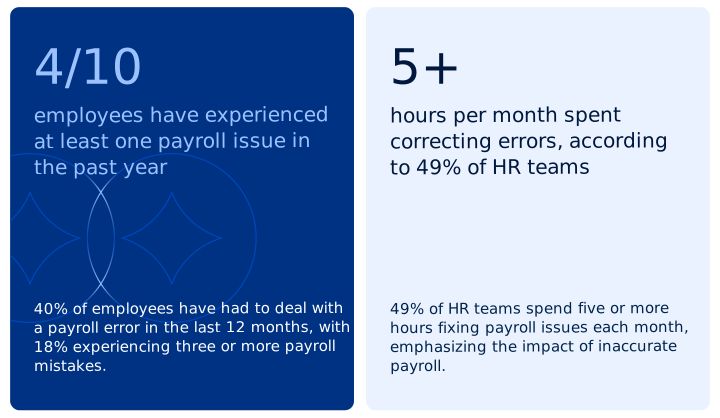
Underlining the critical need for accuracy and openness, our survey illustrates the marked effects payroll mistakes can have on employees and employers alike. Payroll inefficiencies not only damage working relationships but can also create material operational bottlenecks.
"Payroll is a core HR function that should be viewed as inherently people-centric. This is crucial in avoiding an erosion of trust and helping businesses maintain a strong reputation and standing among employees." - Jonathan Goldsmith, VP of Payroll at Remote
More than half of employees have experienced payroll issues
Fifty-three per cent of employees we surveyed had experienced a payroll issue at some point in their career, with 50% reporting at least one incident within the two years preceding the survey. Forty per cent encountered an error in the past year, while almost 11% had been affected within the last month alone.
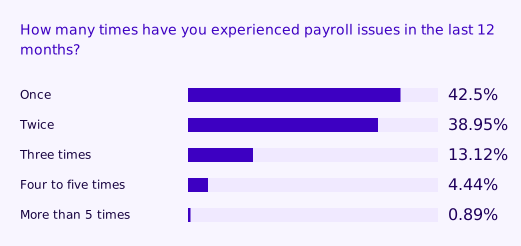
Among respondents who experienced a payroll error in the past year, 43% said it occurred only once, but more than 18% reported at least three payroll mistakes within a single year — with younger workers (aged 16-24) recording the highest frequency of errors.
Our survey of HR decision-makers found that 7 in 10 organisations (71%) that outsource payroll reported an improvement in accuracy, yet employers cannot assume perfect precision — almost half (49%) of HR teams spend five or more hours each month resolving pay-related issues, particularly in larger organisations.
Which groups are most likely to experience a payroll error?
Younger employees are more prone to payroll errors. Over 70% of 16-24-year-olds surveyed encountered a payroll error in the past two years, compared to just 30% of those aged 55 and over. While Gen Z workers are less likely to check their payslips (47% don’t check theirs every month) this higher error rate may reflect lower job stability — younger employees typically change roles more often, for example.
Payroll mistakes are more prevalent in US workplaces. US employees are 26% more likely to experience a payroll error than their UK counterparts, with a quarter of workers in America having faced a payroll issue in the last three months. A higher payslip frequency may be a factor (most Americans are paid every two weeks) alongside a notoriously complex US tax system.
Remote workers are less likely to encounter payroll issues. Perhaps surprisingly, a smaller share of fully remote employees (17%) reported a payroll error in the past three months than those in hybrid or fully in-person roles (both 22%). While fully remote workers check their payslips less frequently (41% don’t check theirs every month, compared to 31% of in-person workers) it may also be that fully remote organisations have, out of necessity, more rigorous and reliable systems in place.
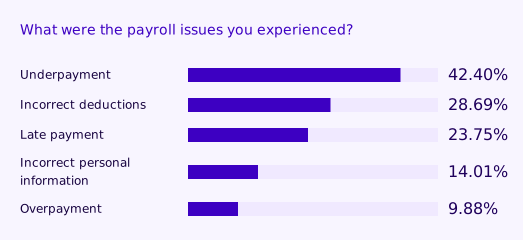
The survey also found that Underpayment is the most common payroll issue. Of those who’d experienced a payroll error, 42% reported that they’d been underpaid, while almost a quarter (24%) had received a late payment. Overpayment was the issue in roughly 1 in 10 cases.
In instances of late payment, the majority of problems are resolved within a week (60% of those who reported a late payment said their wages arrived within seven days), though others waited longer — about 18% waited more than two weeks, and nearly 7% experienced delays of a month or more.
Read the full report and learn how to reduce payroll errors
What fallout can payroll mistakes cause? Download our State of Payroll Report to find out how payroll errors affect employees and the steps you can take to minimise your risk.
Research: 2024 state of payroll report — Rich Text 4
Among the 53% of employees who had experienced at least one payroll error, almost a quarter (24%) cited a delayed payment as one of the problems they encountered.
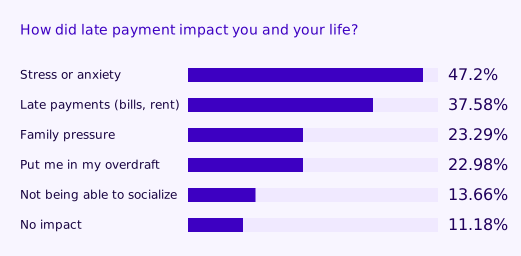
Respondents identified “stress and anxiety” as the most common consequence of a late payment (47%). “Family pressure” was the third most reported effect (23%), underlining that the emotional toll of late pay is often as significant as the financial one.
However, financial strain is also prevalent. Nearly two-thirds of respondents reported that late payslips caused them to miss payments for banknotes and rent, or forced them into their overdraft.
"Payroll affects people, and it’s an emotional thing. It has a significant impact on the morale of the employees in the organisation. After all, if an employee doesn’t get paid correctly, or they don’t get the pay they expect, this could result in them missing a medical payment or something equally as vital.” - Jonathan Goldsmith, VP of Payroll at Remote
By contrast, our poll of HR decision-makers found that, although 95% of employers recognise payroll discrepancies affect staff, fewer than a quarter (24%) consider the effect to be significant impact. A larger share (30%) say the impact is either small or non-existent — indicating a possible disconnect between employees’ experiences and HR leaders’ perceptions of payroll problems.
Who is most affected by payroll mistakes?
Women are more likely to experience payroll-related anxiety. The emotional fallout from payroll errors is felt more strongly by female employees than their male counterparts, with just over half (52%) of women reporting stress and anxiety after a late payment, compared with 42% of men.
Younger generations are more prone to stress caused by late payments. Employees aged 55+ report the lowest levels of stress from payroll mistakes (just 25% say they are emotionally affected), whereas over half (53%) of those aged 35–44 report stress or anxiety — perhaps reflecting greater financial and family commitments.
Employees in the US are more anxious about payroll mistakes.While US workers are more likely to encounter payroll problems, they also report higher levels of stress or anxiety as a result. 56% of US employees said a late payment caused high stress, compared to 35% of the UK workforce.
Remote workers have higher stress levels around delayed payments. Possibly because they may feel more isolated when issues arise, two-thirds (66%) of remote employees say delayed wage payments have caused them stress. This compares with 51% of hybrid workers and 44% of on-site employees.
Payroll errors can harm employee–employer relations
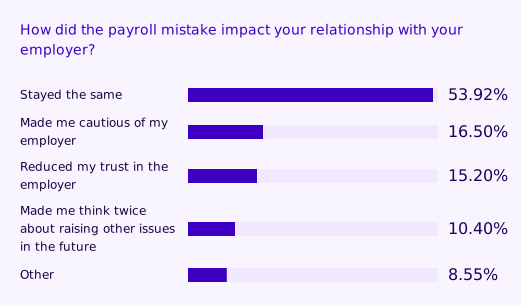
A further major consequence of payroll mistakes is a potential weakening of trust between employer and employee. While more than half of staff said their relationship with their employer remained unchanged after a payroll issue, 42% reported some deterioration.
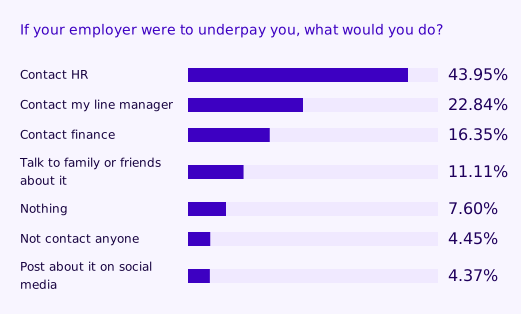
There is also a reputational risk if a payroll error occurs. When asked what they would do if a payroll mistake left them underpaid, over a fifth of employees (21%) said they’d either “make a complaint” or “post about it on social media,” which could have wider repercussions for the business.
“There are functions within a company like payroll that work for the employee, and they need to remember that and own the impact. The after-effects of poorly running payroll to a business are factors like retention, sentiment, and motivation — those are really big things.” - Jonathan Goldsmith, VP of Payroll at Remote
Our survey of HR decision-makers highlights a possible disconnect: almost a quarter (24%) identified faster payments as the primary function they would like a payroll solution to provide. A reduction in errors (21%) was ranked sixth, suggesting employers may underestimate how damaging payroll mistakes can be compared with other priorities.
How do payroll issues affect employee–employer relations?
Increased caution and reduced trust are the most likely negative outcomes.Almost a third (32%) of employees who experienced a payroll mistake said this had either made them more cautious of their employer or decreased their trust in them. Just over 1 in 10 would be more reluctant to raise issues in the future.
Younger employees are more likely to have a negative opinion of their employer due to a payroll issue.71% of employees aged 16–24 experienced a negative change in their relationship with their employer following a payroll error. Conversely, almost two-thirds (65%) of those aged 45–54 said there was no change in employee–employer relations.
Remote workers are less likely to change their opinion of their employer following a payroll error. 60% of remote workers reported no change in their relationship with their employer, which may reflect greater confidence in payroll systems to correct mistakes or simply less day-to-day exposure to managers and payroll staff.
UK employees are more likely to change their opinion of their employer because of a payroll mistake. Just under 50% of UK-based employees said their relationship with their employer had stayed the same, compared to 53% in the United States and 64% in Germany — where employees are less likely to form a negative view of the business.
Overpayments pose a financial risk to businesses
Although underpayment is the most common payroll issue, in around 10% of pay-related errors the employee is paid too much. This can present a material financial risk to businesses, particularly if such mistakes are frequently overlooked.
Our survey asked employees how they would respond if a payroll mistake resulted in them being overpaid by various amounts. In every case most respondents said they would tell their employer (on average, 61% would do so regardless of the overpayment amount), while 5% said they would spend the money without consideration.
More than 1 in 10 (11%) said they wouldn’t notice an overpayment of $100 or under, with that proportion decreasing as the amount rises. This is affected by the fact that over a third (34%) of employees don’t check their payslips every time they receive one. While rarely malicious, this nevertheless highlights the concealed financial risk to employers from regularly undetected mistakes.

“There can be a misconception among employees that an overpayment in your pay packet amounts to “free” money”, says Jonathan Goldsmith. “But employers have a legal right to reclaim any wages that have been overpaid. Businesses must be quick to identify and rectify these mistakes, meaning payroll vigilance and accuracy are key.”
What would employees do if they were overpaid?
Women are more likely to tell their employer about an overpayment than men. 58% of women would inform their employer if a payroll error resulted in them being overpaid up to $100, compared to 55% of men. However, a higher share of women than men (13% vs 9%) also said they wouldn’t notice if they’d been overpaid.
Young people are the least likely to inform their employer they’ve been overpaid. Just over a third (35%) of 16–24-year-olds would notify their employer about an overpayment up to $100, with 23% saying they’d return the money only if requested. Older age groups tend to be more forthcoming, with 67% of those aged 55+ saying they’d tell their employer.
Employees are more likely to keep overpaid wages if they don’t like their employer.23% would choose to keep money mistakenly paid if they disliked the company they worked for, while 13% of those satisfied with their employer would do the same — emphasising the influence of company culture on payroll behaviour and perceptions of benefits.
Employees are more likely to return money if asked by their employer. In all scenarios, on average, 13% of employees would return an overpayment if requested by their employer, versus an average of 9% who would do so without being asked. This underlines the responsibility on employers to be vigilant in identifying overpayments.
Payroll insights by country and sector
Our major 2024 study into global payroll examines the views of employees and HR decision-makers across several countries and industries, revealing how the most affected groups perceive payroll operations today.
We surveyed 2,539 working professionals in the United Kingdom, Germany, and the United States.
We also gathered the views of 1,352 HR decision-makers responsible for payroll in the United Kingdom, Germany, France, the Netherlands, and the United States.
The survey reveals key findings such as how often payroll mistakes occur, the impact these errors have on employees, and the steps employers are taking to mitigate them.
Read the full report and learn how to reduce payroll errors
Assess the fallout from payroll mistakes. Download our State of Payroll Report to uncover how payroll errors affect employees and what you can do to minimise your risk.
Employers should regard payroll as more than a back-office function
Our research highlights the tangible consequences of getting payroll wrong. The financial impact on staff can be substantial – resulting, for example, in late rent or missed bank payments, but employers must realise that the emotional impact of a serious payroll discrepancy can be even more sharply felt.
Naturally, the two issues are frequently connected – the prospect of missing an expected payment or being unable to afford essential items is a common source of stress and anxiety, especially for younger workers who may have less financial resilience and greater family responsibilities. Nevertheless, late payment of wages can still have a damaging effect on employees’ mental health.
As Jonathan Goldsmith emphasises, employers must recognise that payroll is far more than a simple administrative function:
“Payroll is a highly strategic asset. If you’re treating payroll as a back office function, you’re already behind the times. Payroll is a mechanism to help recruit employees and give them a good experience. If you don’t provide them insight into what they’re getting paid, how they’re getting paid, and why they're getting paid that way, you’re doing a disservice to your employees.”
We highlighted erosion of trust as a likely consequence of payroll errors (with more than 15% of employees saying a payroll mistake reduced their trust in their employer), but the impact on businesses can be broader: an ineffective, error-prone payroll operation can sap motivation, damage productivity and even hinder a company’s ability to attract and retain top talent.
“A lot of companies say, ‘We pay our employees well’,” but that is meaningless if staff are not paid correctly at the end of the day. That point is easily overlooked.”
Would you like to learn more about how employees and HR decision-makers view the importance of payroll? Download the full State of Payroll Report for extensive insights into the common reasons for payroll issues, the impact on employees and business operations, and the benefits of outsourcing payroll for organisations.
-1.png?branch=production&width=3840&quality=90&auto=webp&disable=upscale)