
Where to hire report
Tools such as Remote’s Where to Hire Report deliver live analytics on talent pool depth, salary expectations, employment costs and typical benefits by region and country.
The blueprint to finding elite remote developers.
This guide is a must-read for any employer or hiring manager looking for a blueprint to overcome the tricky challenge of hiring in one of the world’s most competitive job markets.
We’ve gathered the specialist knowledge of Remote’s global HR team to share practical tactics you can use to source, attract and retain remote software engineering talent.
We cover common pain points and real-world examples, and we offer practical solutions for employers serious about finding and keeping skilled remote software developers around the world.
We want to help you get ahead of competitors to secure the world’s best remote software engineering talent in less saturated markets. Rather than competing in the intense hiring queues of Silicon Valley, Tokyo, Tel Aviv or Berlin, Remote helps you find the right people wherever they live.
By the end of this guide you’ll know how to assemble a dream team of world-class remote software developers.
Finding the right developer for your business can be tough if you only search locally. Opening your search to global remote candidates widens the pool, but you still need to attract suitable applicants, vet them for cultural and technical fit, onboard them properly, and keep them engaged. It’s a lot to co‑ordinate, so this guide walks you through the full process.
A remote software developer designs and builds computer programs and systems while working from outside a traditional office. Not being tied to a single location means they can bring their skills and expertise from anywhere in the world.
Software development is one of the most common roles for remote workers. Since most engineering tasks don’t require physical presence, where—or sometimes even when—engineers work is less important. Because companies continually need more engineers, many are now opening positions to applicants from multiple countries to expand their talent reach.
Remote software engineers are found worldwide. You’ll discover talent in established tech cities like London, Tel Aviv, San Francisco and Tokyo, as well as in many other regions. You can engage developers as contractors or as employees depending on the work required and the local laws of the country where you plan to hire.
Hiring with strategy is essential to keep your organisation competitive as market conditions shift. Employers open to global hiring can adapt quickly and exploit changes in talent supply. Having the right resources at your fingertips is invaluable for hiring managers tasked with sourcing and retaining remote software engineering talent.
Tools such as Remote’s Where to Hire Report deliver live analytics on talent pool depth, salary expectations, employment costs and typical benefits by region and country.

Remote's free Employee Cost Calculator goes one step further and helps you understand the specific costs of hiring a software engineer in any country.
More specifically, Remote’s 2022 Tech Talent Report surveyed 1,485 global executives and HR managers across the US, UK, Germany, France, the Netherlands and Sweden who are hiring tech staff, to better understand their attitudes toward emerging tech hubs. The report highlights misconceptions about remote hiring that may stop businesses finding top talent in less crowded markets.
Our research found many companies that hire internationally still concentrate too heavily on traditional tech hubs, missing out on value. These established centres show signs of strain in their tech talent markets.
0%
London
0%
Paris
0%
Berlin
0%
New York City
0%
San Francisco
0%
Tokyo
Gartner® Inc.’s recent report, Emerging IT Talent Hubs in 2022, provides insight into the “top existing and emerging IT talent hubs”. The research analysed 120 cities across 28 countries for 15 IT roles (the roles reflect a talent profile based on criteria such as occupations, skills and certifications).
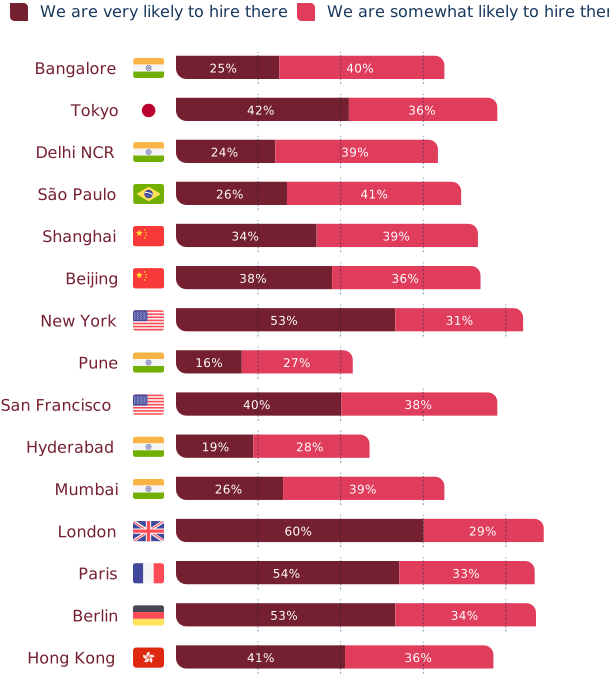
Remote analysed the top 15 emerging tech hubs to see where businesses are hiring remote tech talent, what stops them from expanding, and how to tap into those markets.
The findings show there are plenty of reachable emerging hubs for software development talent suitable for startups, scale-ups and large enterprises alike.
Sourcing qualified remote software engineers that match your company’s needs is challenging in a tight market where top talent can be selective. When planning hires—especially internationally—you must balance short- and long-term goals and address ongoing elements like your global compensation strategy.
From drafting a job ad that accurately describes the role to building an appealing benefits offering and navigating multiple labour markets, there are numerous hurdles. With the right plan and know‑how, however, you can find the right remote developer for your organisation.
"Keep extending your talent pipelines beyond traditional tech hubs. The broader you search across borders, the better your chances of success. I now see this as essential to stay competitive and hire great people. Any cost savings are secondary—without strong engineering talent you can’t progress key initiatives."
Dave Walters, CTO at Hired
Your process must begin with recruitment: define the qualifications that meet your software objectives and write a job ad that reflects them. You also need competitive benefits that will drive applications and draw candidates to your organisation.
Muck Rack is a platform that helps PR teams find the right journalists. With hundreds of staff spread across the globe, the company hired 35 engineers over two years with a 98% retention rate. Nearly a third of those hires were referrals from the internal engineering team, showing strong employee satisfaction and loyalty.
We spoke with Gregory Galant, co-founder and CEO of Muck Rack about the approach behind their sustained success. Gregory outlines three steps recruitment teams can adopt to achieve more consistent hiring outcomes:
“Being fully distributed means we can compete for top talent and hire the best people regardless of location. Our work starts well before interviews, through close collaboration with hiring managers to pinpoint job requirements, including technical skills and values fit. The clarity from those deep dives shapes our sourcing strategy and helps us proactively approach candidates with the exact skills and experience we need.”
“We use a standard interview structure that evaluates technical ability, problem solving and values alignment. Interviewers are trained; we apply structured interviewing to minimise bias and debrief after each interview so feedback is shared openly. Panels include diverse team members to ensure a range of perspectives, whether that’s managers or individual contributors.”
“Technical assessments are a key part of our process, but we keep them manageable—critical-skill tasks that can be finished in 2–3 hours. Since interviews and assessments are remote, candidates have access to the talent team and the hiring manager via Slack so they always have someone to answer questions.”
One of the easiest ways to stand out in a tight market is to pitch your role more effectively than rivals.
Too many organisations treat a job description as just a checklist. That limits your offer’s appeal to high-quality candidates sifting through numerous listings for a compelling opportunity.
A bit of extra effort up front will make your advert stand out. Emphasise growth opportunities, any unique perks, and a sense of your culture and values. Explain how you will support and develop each hire to show your organisation genuinely cares about their progression.
"Job boards attract two main groups: people actively seeking work and people currently employed who might be tempted to move. A plain JD will likely reach the first group; the second needs convincing. Your ad should highlight what the candidate will gain from joining your company. Show why it’s better to do their job with you. Use less ‘Our requirements are’ and ‘Our mission is’ and more ‘You will impact these parts of the business’ and ‘You will be excited about’. Catch the reader’s attention and make them keen to interview."
Yasmine Gray, Senior Talent Sourcer at Remote
Setting clear expectations also appeals to top international candidates. It shows your organisation is professional and that you respect each applicant. Small extras like this help your offer stand out.
Keep your hiring process short and set a maximum timeline. Long processes with many interview rounds, exhaustive psychometric tests, and unpaid technical tasks demand too much time from candidates. Experienced professionals are busy; they won’t tolerate unpaid work and may avoid lengthy processes. A CV conveys much of the story, interviews assess culture fit, and references validate performance.
Busy engineers can’t always commit to lengthy interview procedures. Streamline where possible and make sure you can explain why each step matters to the candidate.
In a market this tight you can’t afford to lose top candidates. Keep applicants engaged by being clear about each stage and the timings involved. Consider adding a note about the interview format to your job ad.

A concise overview like the example below can be added to your advert to set clear expectations and reassure candidates their time commitment will be reasonable:
1
To assess cultural fit and values alignment
2
To ensure matching compensation expectations
3
To assess technical ability and experience
4
Chance for the candidate to ask questions
5
To validate mentality and strategic aptitude
The most effective recruitment teams tailor their approach for hiring remote engineers. Finding world-class developers is hard; the global shortage means you must work smarter and harder to beat the competition.
A strong remote culture is difficult to build and easy to damage, so avoid hires who could undermine it. Look for candidates who share your company values and who are comfortable in a distributed working environment. Give interviewers specific questions to probe this.
Start by prioritising relevant skills and experience. When hiring remote software engineers, emphasise experience in distributed teams and familiarity with the technologies and tools your organisation uses. Autonomous and async working methods work well, but engineers without prior experience in such setups may need a longer ramp-up or could struggle to adapt.
Next, prioritise communication skills in your evaluation. Remote work depends on clear, deliberate communication — this should be non-negotiable. Assess candidates’ comfort with video calls, chat and email to ensure they can collaborate smoothly. Also judge clarity in CVs, cover letters and any emails exchanged during the process.
Offer locally competitive pay and benefits to attract top talent. Salary expectations vary by location and cost of living, so research market norms and adjust pay accordingly—but remember that elite remote engineers often treat competitive salary as table stakes. A compelling benefits package can be decisive.
Finally, show candidates you have a structured onboarding plan to train and connect new hires to their team and company culture. This demonstrates clear expectations for success and reduces uncertainty about how remote developers will be integrated into your processes, tools and people. Effective onboarding is vital for remote engineers to feel supported from day one.
Culture match might not be the sole deciding factor, but if you’re unsure about a candidate’s cultural fit treat it as a dealbreaker. Even dispersed teams suffer from poor fit, which harms productivity, morale and cohesion.

An American backend engineer will likely place great value in health insurance benefits.

An Australian in the same role would place minimal value on this benefit as the local public health Medicare system is excellent.
This is where a global employment partner like Remote can offer the local insight you need to design competitive and compliant benefits at scale for international employees.
Amina Moreau, CEO and co-founder of Radius highlights the value of transparency during recruitment. By being upfront, hiring managers encourage more honest conversations with high-calibre remote engineers to better evaluate mutual fit during interviews.
"Because it’s equally important that our team is the right match for candidates, we start by being candid about who we are, how we operate, what our strengths are and where we need to improve. As a startup we work differently to mature companies, so we’re open about our financial position, what stage we’re at and both the pros and cons of joining a startup. Starting conversations with transparency helps candidates feel comfortable sharing their work preferences, which speeds up the relationship and leads to a truer assessment of alignment."
Amina Moreau, CEO and co-founder of Radius
The answer is simple.
Hiring top engineers isn’t an exact science. Someone who’s ideal for one company could be a poor fit for another. Shift your focus from “finding the best engineers” to “finding engineers best suited to your team”.
Lisbon-based Sergio Pereira is CTO at Bulk MRO Industrial Supply. As an advocate for remote work, Sergio continually looks to improve processes for a globally distributed team. He explains how Bulk MRO assesses culture fit against company values to find the best remote engineers.
"To ensure a candidate fits the team, we involve multiple team members in the hiring process so they can evaluate how well a prospective engineer would integrate with team dynamics and contribute to our remote work culture. This cultural assessment is as important as checking technical skills for the role."
Sergio Pereira, Chief Technology Officer at Bulk MRO Industrial Supply
Sergio’s approach offers useful guidance for leaders wanting to boost retention and strengthen the recruitment process.
Your team must be able to ask the right questions to reveal whether a candidate lives your company values.
Remote’s recruitment team looks for engineers who are team players. The best fit for Remote communicates clearly and is collaborative, ambitious, self-driven and curious.
"At Remote we focus on operationalising our values. We recruit accordingly. There’s a technical baseline to meet and we want developers who can write exceptional code, but we don’t need ‘technical superstars’ who work best alone. We need collaborators. In interviews I ask scenario-based questions to understand how candidates would behave in certain workplace situations. I look for answers that show care and humility—signs of teamwork and collaboration."
Gabriela Suarez, Expert Recruiter at Remote
The first screening call with a recruiter.
Although all interviewers should check candidates against your values and mission, the recruiter screening is the ideal moment to dig into this area.
Use that time to evaluate whether a candidate displays the behaviours you want in an engineer. Recruiters can rule out candidates on cultural grounds, while later interviewers—who have the technical expertise—assess skills and experience.
Once you’ve designed an aligned, balanced and diverse interview process, execute it consistently. A clear process helps remove bias and reduces the risk of hiring someone who doesn’t fit your organisation and culture.
"International hiring offers obvious benefits—you open access to the world’s best talent. Value-based recruitment lays the groundwork for long-term success. Leaders who hire people with shared values can build an inclusive, trustworthy environment that enables a global team to thrive."
Anastasia Pshegodskaya, Director of Talent Acquisition at Remote
Blog

Most growth-focused leaders back the need to prioritise diversity, equity and inclusion (DEI). Fewer teams know how to turn that goal into concrete recruitment actions.
The Remote team is committed to expanding access to world-class employment for anyone, regardless of where they live.
Our recruitment approach is designed to find and open opportunities for underrepresented groups. Below is a shortlist of practices you can implement now to diversify your team and bring fresh perspectives into your organisation.

If you want to diversify your candidate pool, ensure your interview panel reflects different dimensions of diversity. You may not cover every underrepresented group, but avoid a homogenous hiring team. Seek diverse perspectives from stakeholders inside and outside your business and prioritise intentional outreach to underrepresented groups.
This levels the playing field and supports a inclusive process. Consider teachability and potential—especially for junior roles—rather than degrees or years at established tech firms. This increases diversity and helps you discover talent in under-explored countries.
Hiring from emerging markets is often more cost-effective and avoids the competition in saturated hubs. You’ll find motivated professionals who are keen to prove themselves and remain in their chosen location rather than relocating to big hubs. The 15 cities highlighted earlier provide a strong starting point—begin by connecting with local tech communities.
When hiring globally, look for the ‘culture add’ your new engineer brings. Cultural fit is the baseline; seek people who will elevate the team with fresh perspectives, mentoring experience, or community involvement—qualities that indicate commitment and care.
Mastering global compensation and total rewards for a distributed team takes both art and science. The key is putting your global team's needs first. You don’t need identical pay bands everywhere—study local specifics and consider total compensation (salary plus benefits, perks and equity). Remote simplifies this, giving you local expertise to create competitive offers per country.
Increasing diversity, equity, and inclusivity should be ongoing. Lay foundations before you post jobs. Support groups for underrepresented tech talent through sponsorships, mentorships or partnerships so that when you hire, you already have access to diverse communities and have demonstrated your organisation’s value.
Great benefits can be as important—or more important—than a high salary. Remote software developers are in demand and tend to favour companies that offer the best overall package of pay and benefits.
For many employees, even if wages stall, meaningful company benefits create a positive environment and sense of worth. Employers offering competitive and cost-effective value-based benefits—such as flexible hours and async practices—can attract and retain top talent even if they can’t match enterprise salary levels.
Remote software engineers commonly expect more than statutory benefits. Candidates often seek autonomy through flexible and async work, plus a culture that supports diversity, stock options, retirement savings vehicles and more.
Remote’s 2022 Global Benefits Report found that flexibility is a top incentive for tech talent, with employees consistently ranking remote and flexible work highly when evaluating job offers.
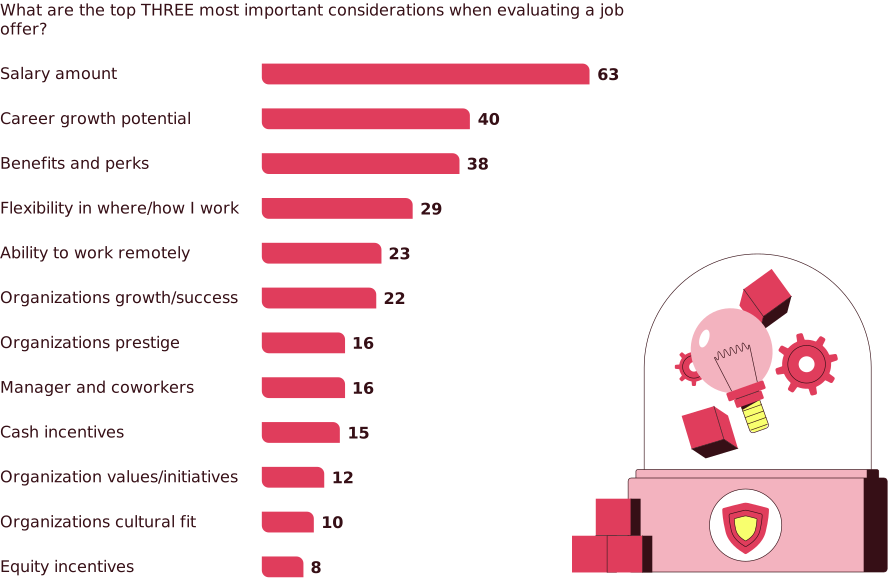
Hiring international engineers brings big advantages, but HR leaders must design an intentional and fair remote compensation plan to attract and retain top talent.
Candidates for remote roles can quickly find a global benchmark and compare your offer to local and international rates.
Many remote engineers value certain benefits over salary alone. Savvy employers use local insight to decide which benefits will attract the best candidates.
People with similar skills and experience should have access to comparable lifestyles in their country of residence.
Remote’s global employment platform helps you attract and retain top talent with locally relevant, compliant benefits in every country you hire. Our global benefits specialists design country-specific benefits packages with the advantage of highly negotiated pricing.
You can provide equitable, best-in-class benefits to remote developers—and to your whole global team—for a fraction of the cost of doing it yourself or setting up a local entity. You can even offer stock options to your international workforce.
Webinar

There are several core benefits employers must provide when hiring internationally. These statutory entitlements—like leave, social security and insurance—vary by country but are non-negotiable for any employer.
This variation affects international employers because benefits offered above statutory requirements in one country may be less valued elsewhere. Private health insurance is a major draw in countries like the United States, where government healthcare is limited; Australian employees, by contrast, place less value on it because Medicare is strong and only 10% of Australian employers offer supplementary health cover.
When recruiting internationally, learn the secondary and non-traditional benefits that matter in each market you target.
Software engineers value autonomy and flexibility as much as, if not more than, many other workers. Non-traditional benefits like flexible hours are attractive, especially to those already working remotely.
Core benefits—such as sick leave, paid holidays, health insurance and retirement plans—are treated by many engineers as non-negotiable. Cutting benefits during downturns can seriously damage satisfaction and retention.
Core benefits—like sick leave, paid holidays, health insurance and retirement plans—are seen by many engineers as essential. Reducing benefits in tough times could jeopardise employee satisfaction and retention.
Learn how to offer compliant and competitive local benefits to everyone, everywhere.
Remote’s 2022 Global Benefits Report found that decision makers hiring internationally use the strong demand for flexible work as a competitive advantage to attract top remote talent.
When leaders decide to offer remote or flexible work, the drivers are usually improving retention, accessing new markets and responding to employee requests and needs.
For remote and hybrid workers, flexibility is essential. In fact, 57% rank flexibility as more important than compensation (40%).
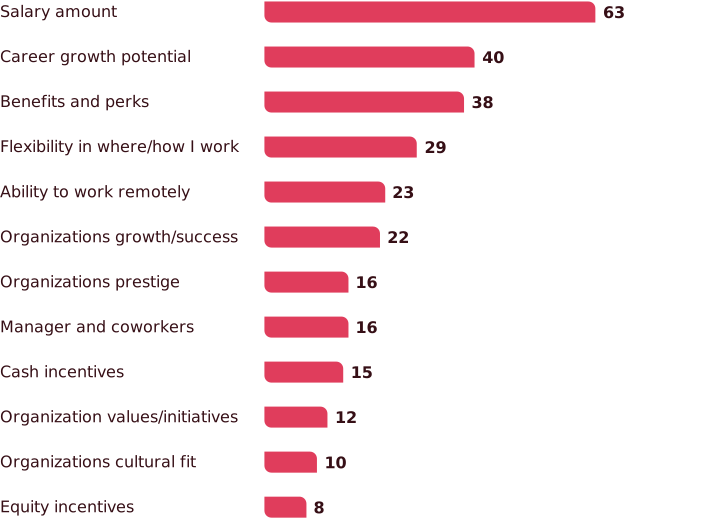
Highlighting flexibility matters: 29% of employees list flexible work and 23% list the ability to work remotely among the top five incentives they consider when weighing a new role.
A strong, localised compensation and benefits programme, paired with a remote-first recruitment strategy, is the key to unlocking global talent pools and leveraging international remote engineering talent.

Deciding pay is harder when your workforce mixes employees and contractors across markets. Start with an employee cost calculator to estimate typical costs by country. Then consult Remote’s Where to Hire Report for insight on where the best hiring opportunities are. Hiring developers from wherever they’re available makes sense in the remote era. It lets you tap an unlimited and diverse talent pool and can improve productivity and competitiveness. Having people in a market where you’re expanding is also useful for local growth.
Hiring an international team member costs more than their base pay. Employer-mandated taxes and contributions can raise total employee costs to roughly 1.25–1.4 times salary, depending on location.
For example, say you want to hire a great software engineer based in Argentina with a salary of USD 60,000 yearly. In this case, you would incur an additional $15,731.76 in Argentina’s mandated employer costs, including your employee’s pension and payments into the country’s social welfare fund and public healthcare systems. You have to look at the whole package, including benefits, not just payroll and taxes, to make your assessment.

For example, say you want to hire a great software engineer based in Argentina with a salary of USD 60,000 yearly. In this case, you would incur an additional $15,731.76 in Argentina’s mandated employer costs, including your employee’s pension and payments into the country’s social welfare fund and public healthcare systems. You have to look at the whole package, including benefits, not just payroll and taxes, to make your assessment.
Be competitive when recruiting and retaining talent. Avoid making insulting offers to potential hires or harming your reputation. At the same time, don’t overpay and risk being priced out or needing layoffs when markets shift. Be thoughtful and use resources like Remote to guide you.
Remote's free Employee Cost Calculator
goes one step further, helping you to understand the specific costs involved in hiring a software engineer in any given country around the world.

There are several ways to hire remote developers overseas. You can open a local entity, or use an EOR or employer of record service.
Remember each country has its own rules for establishing an entity—from physical presence requirements to business and payroll tax obligations.
If you decide to set up an entity, don’t underestimate the investment—both the initial outlay and the ongoing maintenance. It’s not just financial; the time needed to learn the local market and legislation often makes entity formation impractical unless you plan a long-term presence.
If you expect to hire fewer than about 25 people in a country, entity setup may not be cost effective. Costs can include bank accounts, taxes, registrations and possibly a physical office and staff. You’ll also need local legal advice to remain compliant.
Another route is to engage engineers as contractors. This can be simpler than opening an entity, but it carries its own risks.
You may be able to engage people as contractors rather than employees. However, you must classify workers correctly. Misclassification can lead to fines, penalties and even bans on hiring in a country.
Before hiring contractors, ensure the contract would be considered a legitimate contractor relationship under local classification laws.
Working with an employer of record (EOR) can be an attractive option for hiring developers overseas. EORs let you employ developers full-time without opening an entity. If you use an EOR, learn how to evaluate potential EOR partners.
Partnering with an EOR is often the most time- and cost-effective option for global employment in most cases—especially when you need to hire quickly or accept applications from multiple countries. An EOR avoids the need to set up a local legal entity and reduces your compliance exposure. The EOR employs the worker on your behalf and signs a service agreement with your company to protect the transfer of your intellectual property.
What is an employer of record (EOR)?
An EOR is a service that helps companies hire in other countries. EORs manage day-to-day HR tasks like payroll, tax and social contributions, benefits and compliance with local law. When you work with an EOR, they assume the legal risk of employment, helping you scale hiring with far less exposure.
EORs are not co‑employment schemes, like PEOs are. On paper the EOR is the sole employer, though they don’t manage the day-to-day work of your staff.
Think of your EOR as your local HR team abroad. Make sure your EOR has the presence you need in the countries where you want to hire to avoid breaching local law. Research the terminology of the EOR market.
In a survey of over 1,400 hiring managers, Remote’s 2022 Tech Talent Report found hiring managers who plan to recruit in new regions worry about staying compliant when employing international talent.
34% show hesitance to learning local legal requirements for hiring.
31% worry about learning local payroll regulations.
26% say understanding local benefits packages is a challenge they’d rather not tackle.
23% are concerned about managing payroll.
It’s a real concern, but staying compliant when hiring abroad can be straightforward for companies that take it seriously.
Hiring remote software engineers via an EOR is simple and direct if you have the right partner. All you need to do is sign up for an EOR platform and start onboarding employees.
The best EOR platforms will guide you through employment agreements, contract localisation and payroll setup.
Once employees are onboarded, your EOR should handle payroll, benefits and tax obligations. Remote can even provide relocation support and manage equity incentives and stock options for your international employees.
Working with an EOR partner can save you thousands in legal fees and third-party costs—and it centralises your international employee management.
Using an EOR is a useful tool for hiring remote developers. EORs have teams who can open hiring doors in countries where you have no legal presence and offer local insight into talent pools and how to attract suitable engineers for your needs.
We handle local payroll, taxes and benefits to keep you compliant so you can access cost-effective, world-class talent overseas.

EORs can also support your hiring process. To attract top talent and stay competitive, companies must adapt to the new reality where work and home overlap and inclusivity matters for global recruitment.
Throughout hiring, EORs can advise on which benefits will attract remote engineers. Benefits and perks often make or break a final decision. A superior package can give your business the edge when top candidates compare offers.
Many companies underestimate the importance of benefits and focus on salary alone. You can’t rely on the bare minimum if you want to attract and keep top talent worldwide. With the right EOR you can offer competitive benefits packages across the globe, giving your company an advantage when recruiting top remote engineers.
Local labour laws are a mix of statutes, case law and accepted practices. Depending on where payroll is processed, rules can be very protective of employee rights or more flexible in payroll management.
To make a competitive offer you need to know norms and expectations in the candidate’s country—covering compliance basics, payroll practices, tax withholding and benefits administration duties.
Visit Remote’s Country Explorer to find key employment considerations by country in one information-packed library

Minimum wage
Parental leave
Sector-specific benefits
Paid leave
Mandatory benefits
Worker classification
Accounting for all these elements in one country is tough. Add multiple countries and you’d need an entirely new arm of your company to manage the admin. That’s why many companies work with a global payroll services provider who already understands the details.
Not all global payroll services are equal. Some outsource local duties to third parties, which can create a poor employee experience and add risk. If hiring abroad, work with an owned-entity global payroll provider.
Every country handles payroll tax and compliance differently. Onboarding international talent is worthwhile, but don’t dive in without understanding local payroll and tax implications. A global payroll partner is one of the best ways to manage these varied obligations.
Blog

Remote provides employer of record services in countries worldwide. This guide gives everything you need to know about EORs and how they operate: keeping you compliant with onboarding, payroll, taxes, benefits and more!
Paying remote software developers can be complex. The process can be straightforward, even if you are hiring international employees, but you must resolve several key considerations before onboarding and paying new team members.
First, decide the worker’s classification. Should you engage remote developers as a contractor or an employee? This is not always straightforward: local employment laws matter and misclassification carries risk.
Misclassification happens when a worker is labelled incorrectly, whether by mistake or intentionally. While penalties are harsher for deliberate cases, companies still face consequences for honest errors. Regulators look at behaviour: if you treat someone like an employee, they may be deemed an employee regardless of your intention.
There are other practical questions about paying international staff. Consider:
In what currencies will you pay salaries and invoices?
Do you hold currency accounts for each country where your workers live?
How will you transfer money—via banks or fintech providers?
How will you pay employees who are relocating and don’t yet have a local bank account?
What payment arrangement does your new employee prefer—local currency or yours—and is it legal?
How will you manage foreign exchange fluctuations?
Each country has rules about how to pay remote workers, including pay frequency, statutory benefits and withholding tax. Know these requirements before hiring to avoid fines or penalties.
Resources

Whatever you decide, check local rules and work with a trusted global employment partner that can spot issues and reduce the risks of hiring in a new country.
Remote owns local legal entities in every country where our EOR services operate. Our global payroll software hub lets you manage payroll and taxes, administer benefits and ensure compliance for all employees worldwide.
Remote is a leading employer of record and our global payroll platform is built to help you accelerate international hiring.
Simplify payments for both full-time employees and contractors in our easy-to-use platform
Ensure compliance with local labour laws with support from our international legal team
Reduce payroll costs and streamline payment processes
If you’re ready, you can sign up now to begin onboarding employees and contractors worldwide in minutes. Have questions? Contact us and one of our global employment experts will offer specific advice to help grow your team.
Companies hiring engineers abroad must understand the relevant tax implications (employer taxes vary by country).
Large multinational firms have HR teams to manage payroll tax and compliance worldwide. For small and medium businesses, limited resources make compliant payment of international employees challenging without adding payroll or legal staff in each country.
An EOR simplifies taxes. Remote’s platform is designed to keep you compliant and help navigate different tax systems. Partnering with Remote removes stress from your finance team and prevents non-compliance risks. An EOR manages global payroll compliance on your behalf so you can grow staff without breaching international laws.
Running global payroll includes much more than issuing pays on the first of the month. Depending on the country and the type of employee, payroll can involve withholding taxes, computing wages and complying with local labour laws. This is time-consuming for HR, payroll, finance and legal teams.
Resources

Stock options are a great way to attract and retain talent, but can be tricky for private companies. You might wonder how to extend stock options to remote developers or how to legally expand an existing plan overseas.
An employee stock ownership plan (ESOP) is a powerful retention tool. Employees are more engaged when they share in company growth. Profit sharing, stock options and purchase plans help reward staff for their contribution. Offering stock to employees overseas can be complex, though.
Resources

Remote allows you to manage international stock option services for your global team, handling setup and management of other equity incentives. We help bring international employees into your ESOP legally and handle tax withholding in multiple countries so you get global equity plans without the admin burden.
To benefit from offering stock options to international staff, plan and execute your ESOP strategy carefully. Consider where employees live, tax treatment and what your complete global benefits packages should include. Whether you want to offer stock to one remote developer or an entire distributed team, Remote can help.
Our equity experts guide you from equity planning through tax withholding and reporting

Understanding the difference between contractor and employee is essential. Each has pros and cons, and misclassification can be costly.
Deciding whether to engage an international contractor or hire an employee requires a cost‑benefit analysis and an assessment of risks around contract management, local labour rules and compliance. Knowing how to stay compliant is critical to avoiding legal and regulatory penalties.
free calculator
Use our free employee misclassification risk calculator to find out your risk level - and what you can do to fix it.

An international contractor lives in another country and performs work for your company but is not a full-time employee. You are their client rather than their employer. An international contractor is not your employee and typically agrees to work:



International contractors are responsible for the work they deliver and may have multiple clients. Contractors are effectively self-employed and run their own businesses.
Employees typically work over a longer term, often exclusively for one employer. They may manage teams or handle ongoing projects. Employee contracts generally don’t have a fixed end date—classification risks hinge on duration and duties.
Employees usually work long-term and often solely for one organisation. They may manage teams or take responsibility for ongoing projects. Unlike contractor agreements, employee contracts generally lack expiry dates, and classification risk often depends on work duration and responsibilities.
When hiring remote developers, consider the projects they’ll undertake and who will own the IP. Remote work alters that dynamic and introduces new risks.
If contracts aren’t compliant and workers are misclassified, you could find a contractor owns IP you assumed belonged to your business.
That’s not to say companies shouldn’t hire employees abroad—on the contrary, global teams are a major asset. But take care to avoid unnecessary risks as IP laws differ by country and you must understand local nuances to protect your business.
Remember contractors may split attention between your work and other clients. Understand the legal protections around NDAs, local IP law and how information shared with a developer fits into those protections.
To help protect your IP, Remote created Remote IP Guard so you receive the maximum transfer of IP rights when hiring internationally.
Working with remote developers can be challenging. Many prefer flexibility and don’t thrive in rigid environments. They want the freedom to work when they’re most creative and to experiment, test and iterate. When considering how to manage remote employees, software engineers are often a primary focus.
Many developers prefer to work at their own pace. This model can challenge organisations used to a 9–5 rhythm. When hiring internationally you’ll need to accommodate various schedules and time zones. The solution is often asynchronous work.
Asynchronous (async) work enables remote developers to perform at their best at times that suit them. Async communication doesn’t expect instant responses, letting people focus and reduce pressure. The key is building processes that allow autonomy and trusting employees to deliver.
Multiplexing is breaking large tasks into smaller, manageable pieces. This helps people complete projects faster and gain positive reinforcement as tasks finish. Smaller tasks let employees move between work without being overwhelmed by large monolithic projects.
Asynchronous communication supports independence. It makes outcomes less dependent on who planned or carried out a task. Async practices promote good documentation, public progress records and long blocks of deep work.
In async work, action means not waiting for someone to give the next instruction. This attitude—acting with initiative—is crucial. It’s about caring for the bigger picture and moving forward even when decisions or inputs are delayed.
There are times when work isn’t ready, tasks aren’t planned or decision-makers aren’t available. Successful teams execute regardless, refactor later if needed, and avoid wasting time waiting.
In short, async work isn’t about procrastination or isolation. It lets people reach a flow state to deliver high-quality work efficiently. Async practices help remote developers focus on outcomes instead of micromanagement.
Traditional synchronous planning kicks off tasks in bulk. While not inherently bad, the system moves at the speed of its slowest element—delays cascade through stages because each step depends on the prior one.
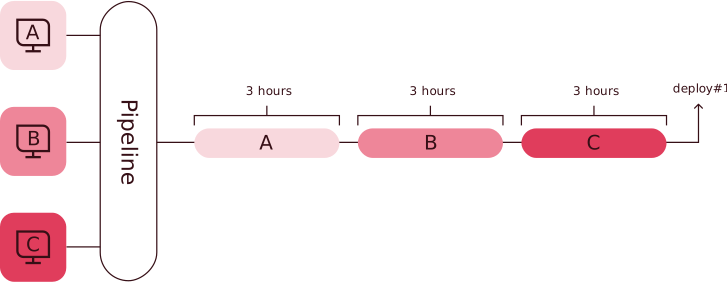
The workflow diagram shows a three‑step software development pipeline organised synchronously. To deploy a feature the team must complete tasks A, B and C sequentially, which can slow delivery—especially across time zones.
Async planning breaks tasks into smaller units and ships minimum viable changes (MVCs) frequently. This approach increases delivery cadence and lets you measure impact and react quickly to feedback.
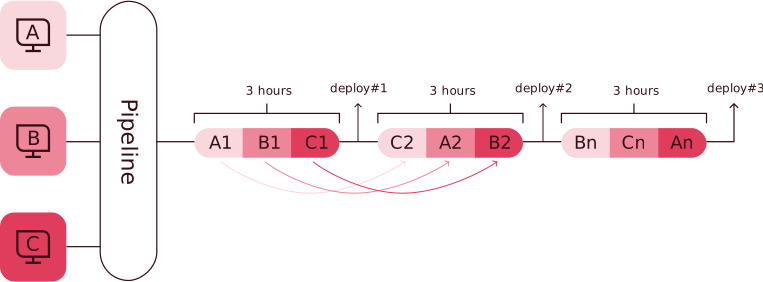
By separating Tasks A, B and C you can achieve three times as many deploys as the synchronous example. Multiplexing tasks with async methods gives more time to validate impact and to roll back or adjust as needed, shortening iteration time significantly.
Overall, async methods let distributed engineering teams multiplex tasks, combine work to move faster and continue delivering across time zones without waiting on other stages.
Protecting your IP is crucial. How can you keep assets safe when remote employees and contractors around the world may be working for multiple clients?
Protecting IP means recognising that creation is cross-border. Some countries favour the commissioner, others the creator. That doesn’t automatically give contractors ownership, but you must be careful drafting contracts and working with people abroad.
IP rights are straightforward when everyone works on company time in the same office. Employees produce work using company resources and that work belongs to the company. For tech firms with distributed teams, IP rules can be more complex and some countries lack regulations covering all tech IP scenarios. Companies with foreign engineers, product managers and other tech roles must be vigilant.
Working with an EOR like Remote gives you the knowledge and security to mitigate IP risk. Remote offers robust IP and invention rights protections through Remote IP Guard, our proprietary system for international IP protection. As a leading global employment solutions provider, Remote helps companies protect IP across dozens of countries.

Hiring a remote software developer can seem daunting. First commit to improving your team—then partner with professionals for legal, compliance and payroll support, whether via an EOR or local partners and your own entity.
There will be hurdles along the way. Stay the course and assemble the right resources—finding the right developers will strengthen your team and boost innovation.
Opening your company to global remote software engineers helps futureproof hiring and builds a foundation for sustained success.
Remote provides the resources and flexibility to fill gaps and give protection where you need it most. Contact our global team if you’d like more information on how to start hiring and paying remote software developers.
